|
|
|
The History of Amateur Radio
Ham, the poor operator (IV) Any amateur radio wonders one or another day what could be the origin of the word "ham". There are at least three possible origins. The first "legend", because never confirmed, tells that the word was given in G. M. Dodge's The Telegraph Instructor in the XIXth century, even before radio. The first wireless operators were landline telegraphers who left their offices to go to sea or to man the coastal stations. They worked in "plain text", bringing with them much of the tradition of their older profession, including jargon. Using spark transmitter, each spark occupied the whole spectrum or almost. If stations were too close each another this caused jam and nobody could receive any message. Government stations were concerned with this QRM but also ships, coastal stations and of course the increasing number of amateur operators; all competed for time and signal supremacy in each other's receivers. Among these amateurs, some stations emitted with 2 kW and, like today, some of them jammed all the other operations to a few hundred kilometers around. When this occured, frustrated commercial operators would call the ship whose weaker signals had been blotted out by amateurs and keyed back : "SRI OM THOSE B@$%#! HAMS ARE JAMMING YOU". Amateurs, possibly unfamiliar with the real meaning of the term, picked it up and applied it to themselves and wore it with pride as a word qualifying their activity... As the years advanced, the original meaning has completely disappeared. The second version tells that it is maybe in 1910 that the word was invented. Before the callsigns where regulated a powerful station able to emit at 5 kW and that everybody could hear at all hours of the day and night at distances of over 800 km (500 miles) operated with the initials H.A.M. No one knows if this rumor is true or false.
The last version tells that the word "ham" was invented in 1933 for a publication dealing with amateur radio. But I have no more detail. In my humble opinion if the HAM station existed there would have had archives about it, but there are none. The first and the third "legends" are both likely but are not confirmed. In all cases "ham" became synonymous of amateur radio. In 1911, Modern Electrics printed 52,000 copies of his magazine. There were 10,000 amateurs in the USA, as many or almost in the United Kingdom and probably as many in gathering all other countries together. With tens of thousands of stations on the air, both amateurs and commercials, the level of interference became a serious problem, especially in marine communication. Due to their poor efficiency, it was not unusual that one spark amateur station transmits over a broad spectrum exceeding 100 or even 300 Kc, depending on its coil diameter and output power ! Ships, because of their restricted antenna length were lost in this QRM and experimented difficulties to establish routine communications when other stations, more powerful, were transmitting. There was also deliberate interference created by commercial stations jamming voluntarily the transmissions of other companies. At last the US Navy used inefficient and outmoded equipment and suffered much from excessive interference. Due to all these complains, the U.S. Congress took a serious look at wireless regulation. But wait a moment, I have just received a wireless message that will, I sense, dramatically alter the future of the wireless communications. 1910 : Birth of the first Wireless Club This is 1910 that was founded the first national radio society in the world, The Wireless Institute of Australia (WIA). It was quickly followed in the spring of 1911 by the foundation of the first Wireless Club of Great Britain in Derby, near London. J. Parsons acted as the first Secretary and the station callsign was QIX. Quickly books were purchased and a lending library started. The Club gave valuable advice to other amateurs fan of wireless and on August 12, 1912 the Amateur Radio Movement was officially recognised in the U.S.A. The second organization was the London Wireless Club that was formed on July 5, 1913 and renamed the Wireless Society of London on October 10th. Its first president was A.Campbell-Swinton until 1920. The Club kept its name until 1922 when it became the famous Radio Society of Great Britain (RSGB). 1912 : The Titanic Tragedy On Monday, April 15, 1912, at 12:30 AM, in the middle of the night, the R.M.S. Titanic struck an iceberg in the North Atlantic near Canada and sank at 41°46' N, and 50°14' West. Thanks to wireless, and the first S.O.S. in history, 745 passengers were saved but 1595 persons died in this accident among them some of the most prominent persons in the world.
Behind this disastrer, it has been argued that the number of survivors could have been doubled or even tripled, if there were stronger wireless regulations in effect. Indeed at least three problems appeared and increased the slow response of rescuers. First, the radio operators were only on duty during the "open hours", thus only at daytime. Any event could thus occured at night without warning. Then, in 1905, the Morse code "SOS" (that does not mean Save Our Souls but became de facto) was adopted by German ships for signifying distress while the British marine, working with Marconi operators, wanted to keep CQD (General Call Disaster that some translated by Come Quick Disaster) as a distress signal. Marcon had first decided to use SOE, but the small "E" dot could easily be lost in QRM and one suggested to replace it with an S, as in repeating three time the small tune the operators had much more chance to arrest the attention of anyone hearing it, hence SOS, that was adopted at the Berlin Radiotelegraphic Convention in 1906 as the official international standard for distress calls. But Marconi operators were slow to conform, and until 1907 Marconi companies continued to work with the "CQD", associated, if necessary, to SOS. At last, there was a commercial war between Marconi and his German competitor, Telefunken, that extended down to the individual radio operators. In these early days of telegraphy, where the Stock exchange was growing fast and gave the chance to small like major companies to increase their benefits, the smallest part of a market took at the competitor meant a probable increasing of shares price at short time. This is this context of commercial war that no routine traffic, even in an emergency, would ever pass from a Marconi station to his competitor. This arrived at such a point that when a "Marconist" was on the air, the others would be shut out, and often, the rules was respected. This
story is interesting to remind because it emphasizes the problem of
security aboard the ship, and the lack of a standard wireless regulation. So
I suggest you to read the next dedicated page and to come back to know the
consequences of this affair. To
read : The Titanic Tragedy, sunk
between CQD and SOS The
Radio Act of 1912
On
May 18, 1912, Senator Smith introduced a bill in the Senate. Among its
provisions (rather long) note a recommendation or rather a "command" for more security on ships, obliging for
example maritime companies to engage up to three wireless operators per
ship to ensure a 24-hour duty, a decision that was fully justified. To avoid
"ownership" of the spectrum by the Marconi Company, Senator
Smith wanted that licenses be now required, issued by the Secretary of Commerce. Each
Government (Police, Forest, etc), Marine, or Commercial station would be authorized a specific
wavelength, power level, and hours of operation. The
initial legislation had considered the elimination of all private, non
commercial stations, thus including amateurs. At the first reading the Congress
realized that it would be hard and expensive to verify its application. An
anonymous spark gap US hamshack starring a huge HV helical
transmitting inductor. Take care OM, it's HV ! Since it was a "well known fact" that long
wavelengths were the best to work, and that anything below 250 meters was
considered "useless" except for local communication, a compromise was found.
Amateurs received the 200-meter band and below (1.5 Mc and up), where they could
work 40 km (25 miles) maximum. In fact Senator Smith thought that amateurs
would die out in a few years by lack of means and support. In
retrospect the Government thought that the only really useful frequencies for
long distance communication were the very low frequencies between 100-1000 Kc
(3000-300 meters). Thus, this regulation offered to the
ham community an apple for the thirst but not really a bandplan suited for experimentation,
and their survive seemed to be a question of time. This is thus under these
conditions edicted by a state monopoly and without dialogue that amateurs
were relegated to the wavelengths of 200
meters and below (1.5 Mc and up), the equivalent of all the spectrum above
roughly the AM broadcast band, generally thought useless for DX communications. In
the new law administered by the Secretary of Commerce, amateurs considered as
"private stations" were also limited to a maximum power of 1 kW. At
first, it appeared unfortunately that bureaucrats were correct. Before the Radio Act,
there were an estimated 10,000 US amateur stations and still a handful outside
the U.S.A. Now, there were only 1200 licenses
issued by the end of 1912. Amateurs encountered difficulties to get their
spark stations going on 200 meters, and, when they did, they discovered their
maximum range was 40-80 km (25-50 miles) what reduced by ten the
range they had on the shorter frequencies ! It seemed that there was no future
for amateur radio. But "the air" doesn't make the song... 1912
: the Q code To reduce
the cost of messages that were calculated by word, elaborate commercial codes were developed,
encoding complete sentences in five-letter groups that were sent as
single words. Example : "AYYLU" meant "Not clearly coded,
repeat more clearly". Very soon standard abbreviations were used by
all operators of a same company or country. Used in their formal "question/answer" sense,
their meaning varied depending on whether they were sent as a question or
an answer. So, the abbreviation "RST ?" requests to the contact
to transmit his "RST" or Readability-Signal Strength-Tone
report. See this file for more details. By
1909, the British government modified these abbreviations and replaced
them by a standardized and international code named the "Q code"
as all abbreviations began with the Q letter. This code was defined as
"a list of abbreviations [...] prepared for the use of British
ships and coast stations licensed by the Postmaster General".
The first list included 45 abbreviations in Q codes. However, until the Titanic
tragedy on April 15, 2012, the Q code as the Morse code (and the famous
SOS) was not used by all companies yet. So,
end 1912 the Q code was officially included in the International
Radiotelegraph Convention Regulations and effective on July 1, 1913. The
Q code was instituted in order to facilitate communication between maritime
wireless operators of different nationalities. It is used to transmit a large
amount of information from the adjustment of frequency to distress information
or related to safety, urgency, identification, name, route, transit, strength of signal, quality of
signal, keying, meteorology, and more. The code was defined as follows : -
The Q code groups range from QOA to QUZ. -
The QOA to QQZ series are reserved for the maritime service -
Certains Q code abbreviations may be given an affirmative or
negative sense by sending, immediately following the abbreviation, the
letter C or the letters NO (in radiotelephony spoken as: CHARLIE or NO). -
The meanings assigned to Q code abbreviations may be amplified or
completed by the addition of other appropriate groups, call signs, place
names, figures, numbers, etc. -
Q code abbreviations are given the form of a question when followed by a
question mark in radiotelegraphy and RQ (ROMEO QUEBEC) in
radiotelephony. -
Q code abbreviations with numbered alternative significations shall be
followed by the appropriate figure to indicate the exact meaning intended.
This figure shall be sent immediately following the abbreviation. -
All times shall be given in Coordinated Universal Time (UTC) unless
otherwise indicated in the question or reply. After
more than 100 years, these specifications have not much changed.
Today the full Q code includes hundreds of
abbreviations, some being specific to the aviation (e.g. QFE, QNE and
QNH), to the aeronautical service as defined by ICAO (QAA-QNZ code range),
to the maritime service (QOA-QQZ code range), and of course it includes
the QRA-QUZ code range assigned to all other services including amateurs.
These international abbreviations were officially approved in 1927 by the
Washington ITU Radio Regulations and reviewed in 1947 by the ITU
Radiocommunication sector (ITU-R). To
download : ITU
Radio Regulations - Appendices (PDF, 7 MB), 2004 Includes
Appendices 14 and 15 related to phonetic and Q codes
Lee
de Forest's triode vs. the King Spark Hams
had difficulties to get effective communications on 200 meters (and in fact on
any wavelength) because the spark transmitter and the unamplified receiver were both
extremely inefficient. There was well some shy development in the vacuum tube
area but these devices cost a lot of money, they provided quasi no amplification,
and were power hungry. In
1908, after have invented the vacuum diode like the funny but operational
one displayed at right, the Englishman J.A. Fleming developed the first triode but the device was not very
efficient and expensive. Spark gap transmitters and crystal receivers
reigned on the air until
1912, when a 22-year old amateur made an important discovery. A
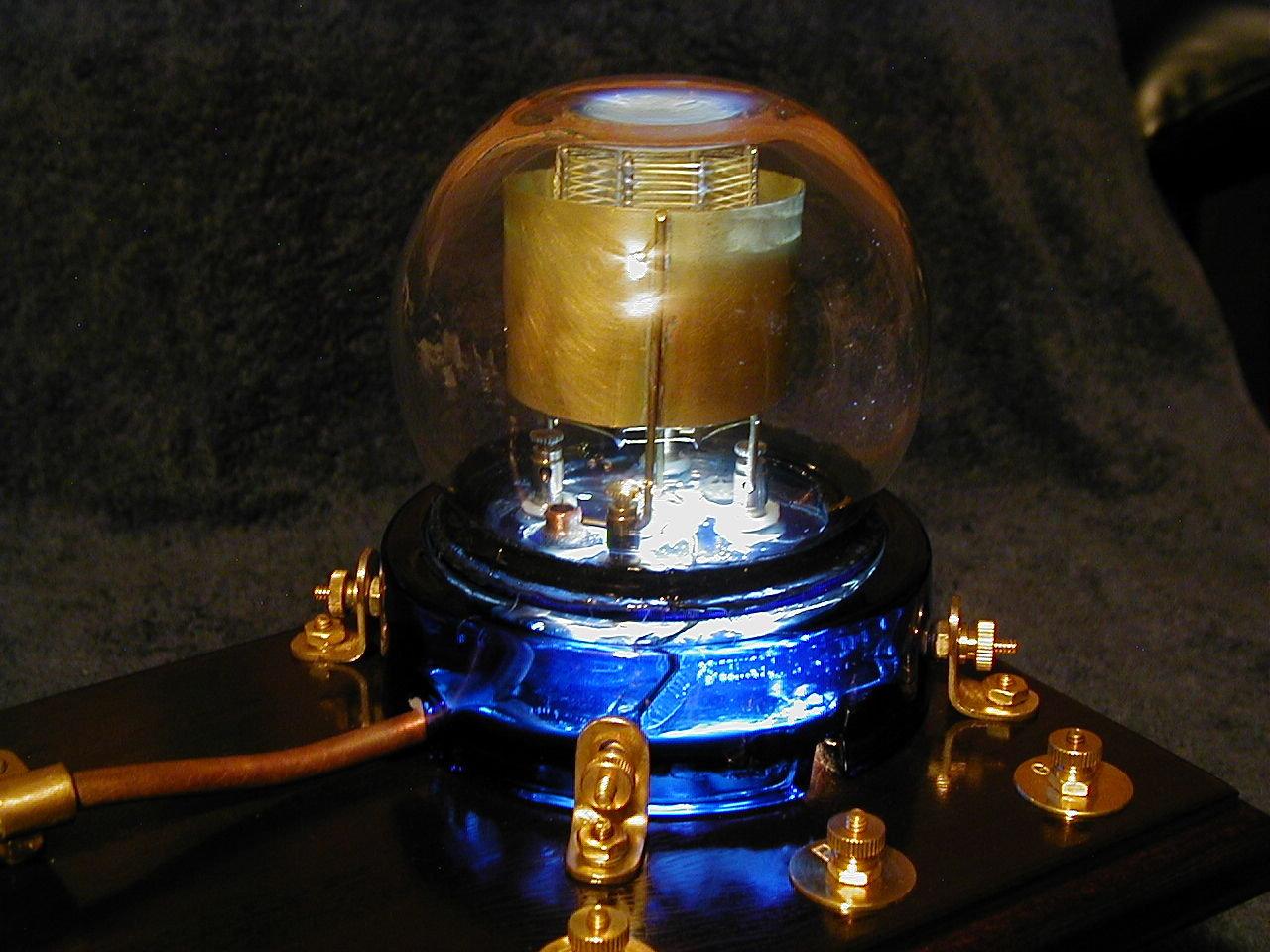
thermionic triode or "button tube" switched on and
standing on a superb blue socket. It was built by H.P.Friedrichs,
AC7ZL, from the idea of Lee de Forest's Audion. The american electrical
engineer Edwin H. Armstrong bought a Lee de Forest's Audion of Old for his
receiver. Unsatisfied with the poor amplification, he changed the circuit and "fed back" a
portion of the output signal back to the input to get a re-amplification. Thanks to
this stratagem he got an amplification factor 100 times stronger than the
input ! Better, when there was much feedback, the tube began to oscillate, and
thus generated stable RF. This
discovery permitted amateurs to use vacuum tubes offering a gain
of 2000 times and more ! This solution placed immediately the
"old" spark design to the back stage. Now a broad
inefficient signal that took hundreds of Kc of bandpass,
oscillated on a stable and pure frequency thanks to the modified Audion.
The signal was so pure than a continuous wave could be emitted on
one frequency rather than a broad and intermittent wave on almost
all the spectrum. The "C.W." acronym was born and with it this
revolutionary discovery revitalized the Phoenix; radio amateurs could
survive and even grow ! Although
Armstrong took more than 10 years to develop the stability of both
transmitters and receivers for CW, realizing the importance of his
"regenerative" design, but short of money to develop its
invention, in January 1913 he took the wise decision to notarise his
circuit.
In
1913, Lee de Forest improved the triode invented by R.von Lieben using a
positive feedback, and quickly after AT&T developed the first vacuum
tube repeaters for its new telephony network. But these triodes offered a
low gain, about 20 times, and had unsollicited capacity.
To get greater
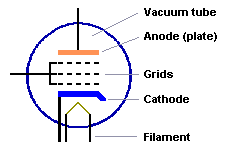
amplification, additional grids were added to these tubes. Tetrodes come
with 2 grids, the 2d being called the "screen" grid because it
screens, or isolate, the control grid from the plate. Tetrodes produce
output signals about 600 times greater than input, and pentodes,
constituted of 3 grids, amplify the signal about 1500 times ! This time
Lee de Forest's triode detroned the King Spark ! Next chapter
Page 1 - 2 - 3 - 4 -
5 - 6 -
7 - 8 -
9 - 10
- 11 - 12
- 13 - 14
- 15 - 16
- 17 - 18
- |