|
|
|
The market of solar telescopes
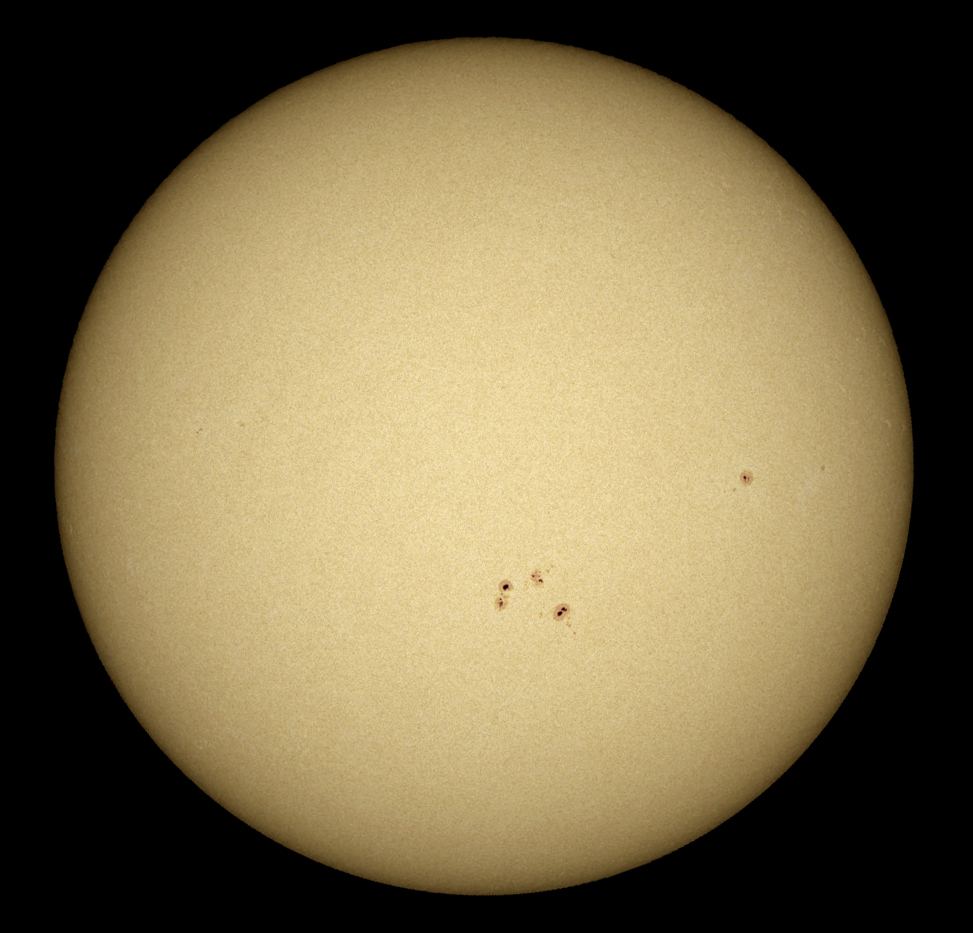
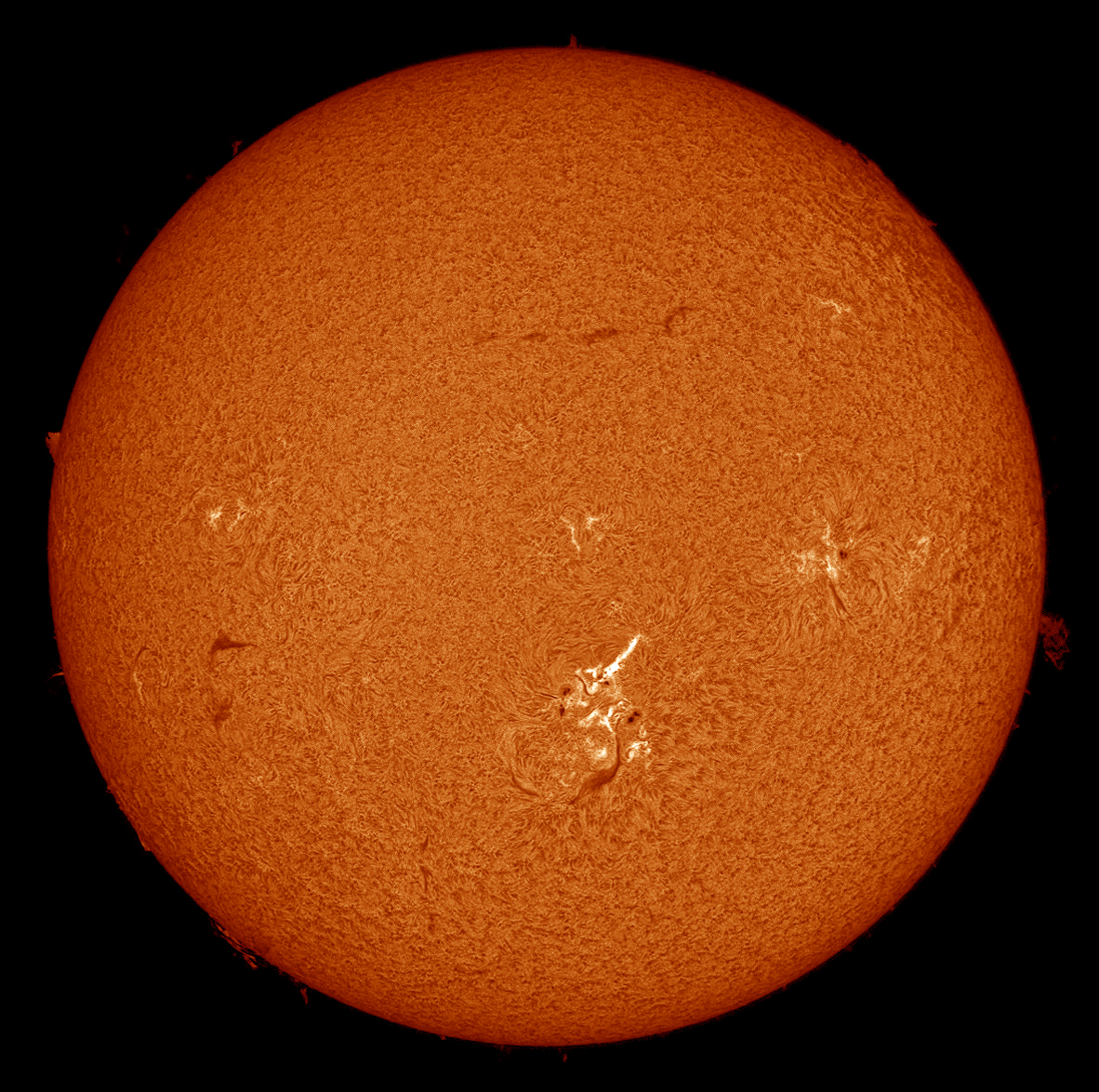
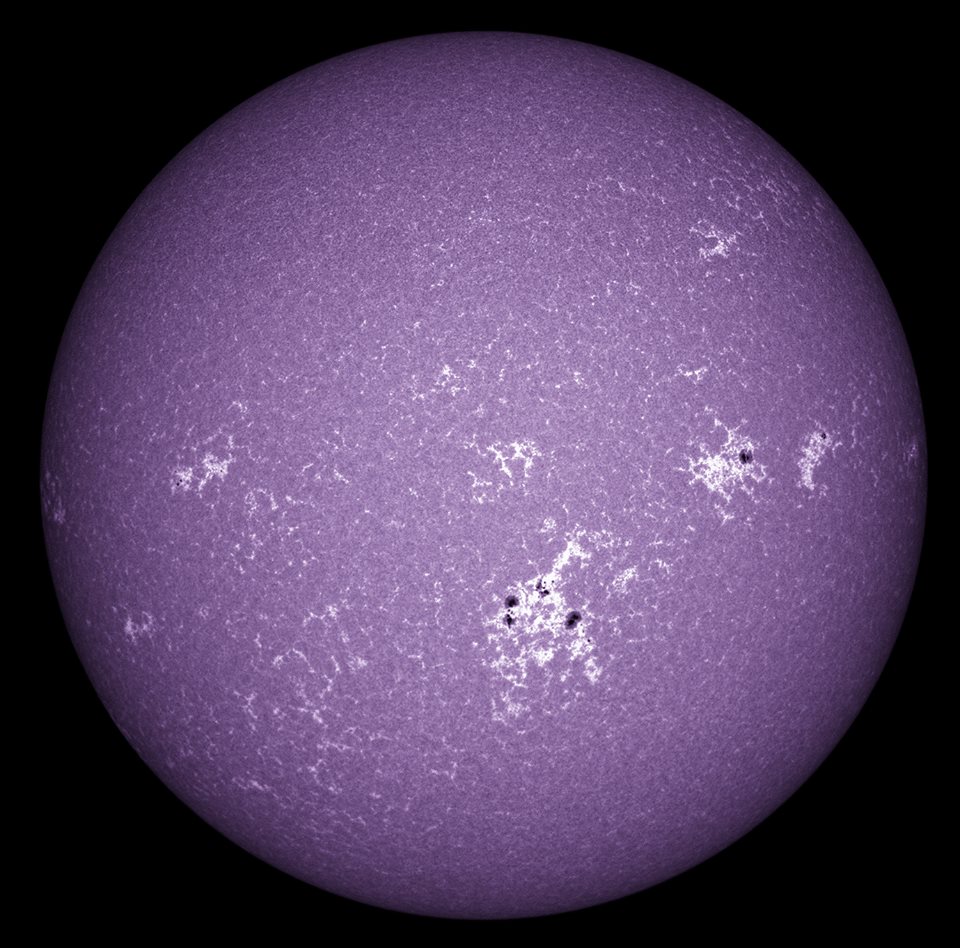
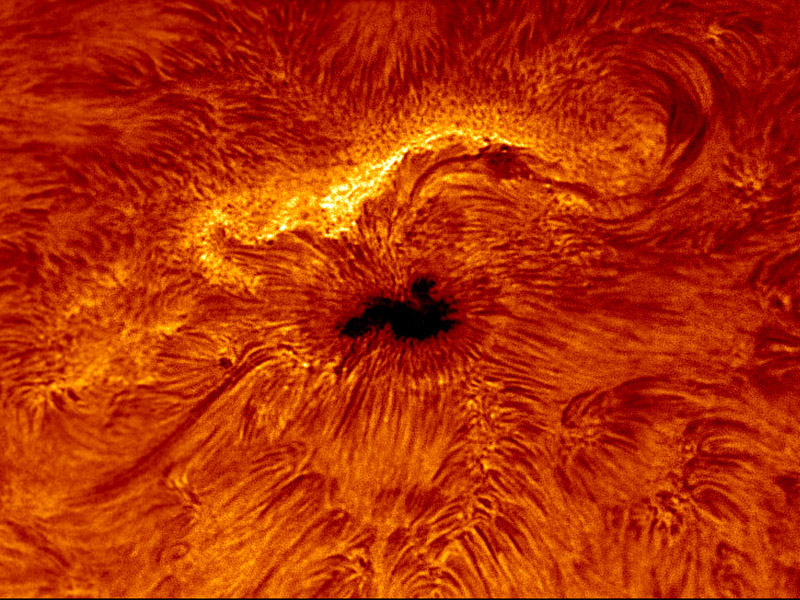
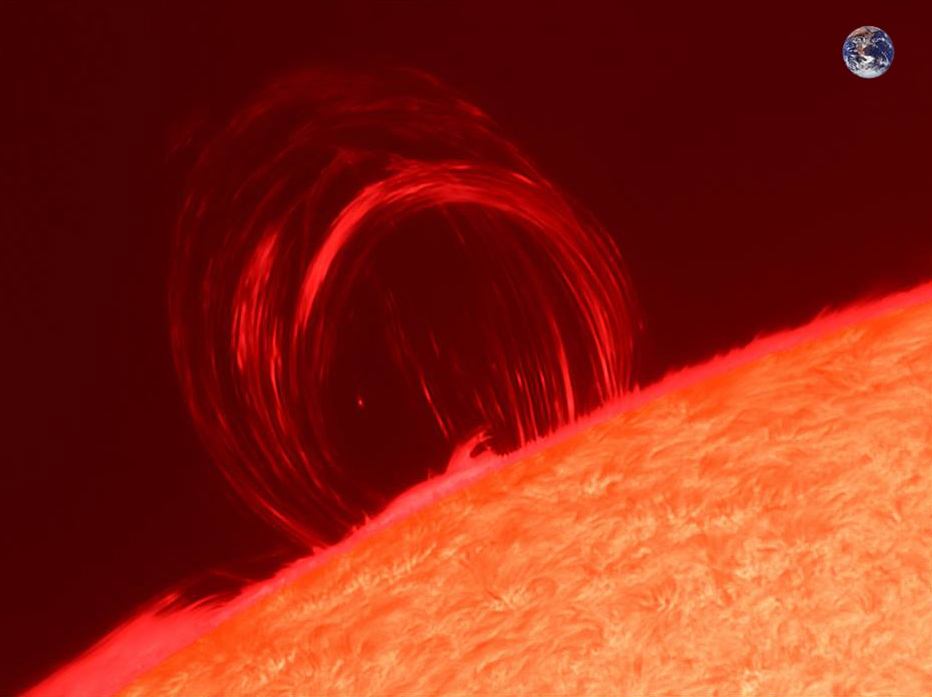
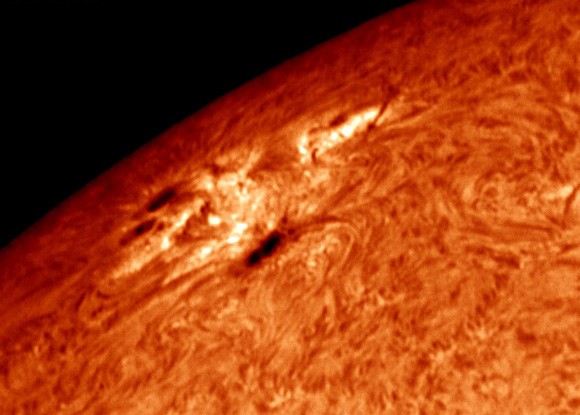
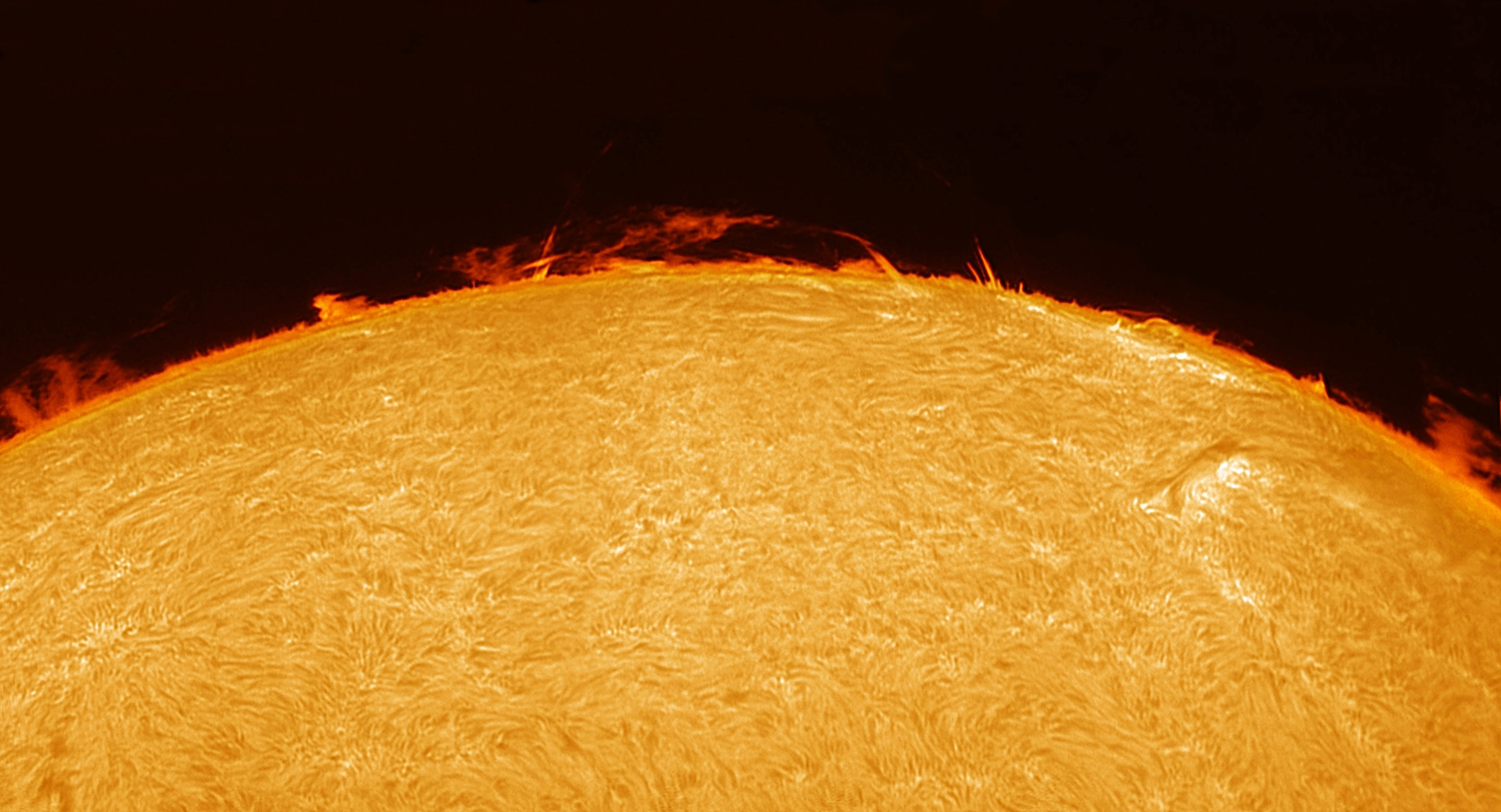
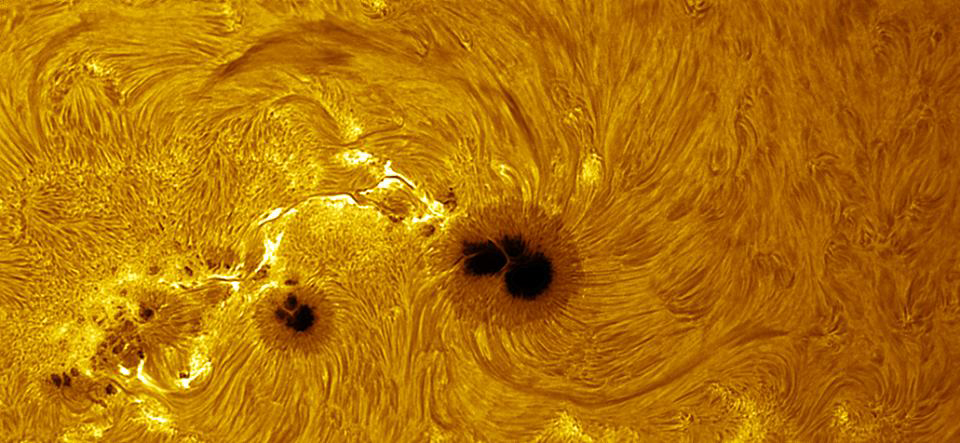
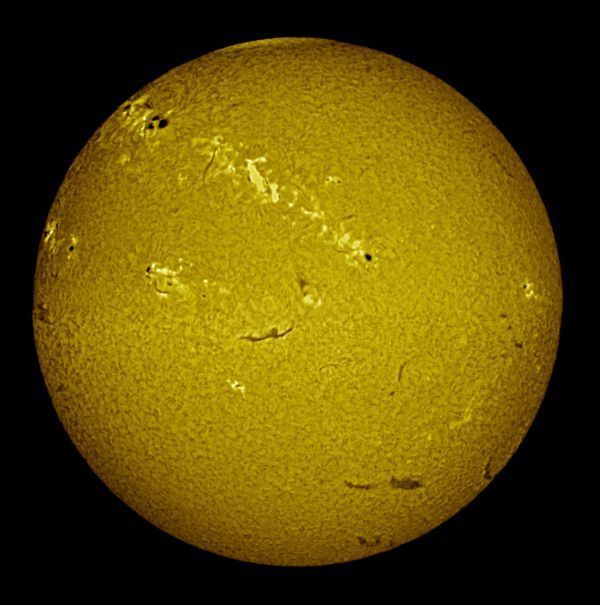
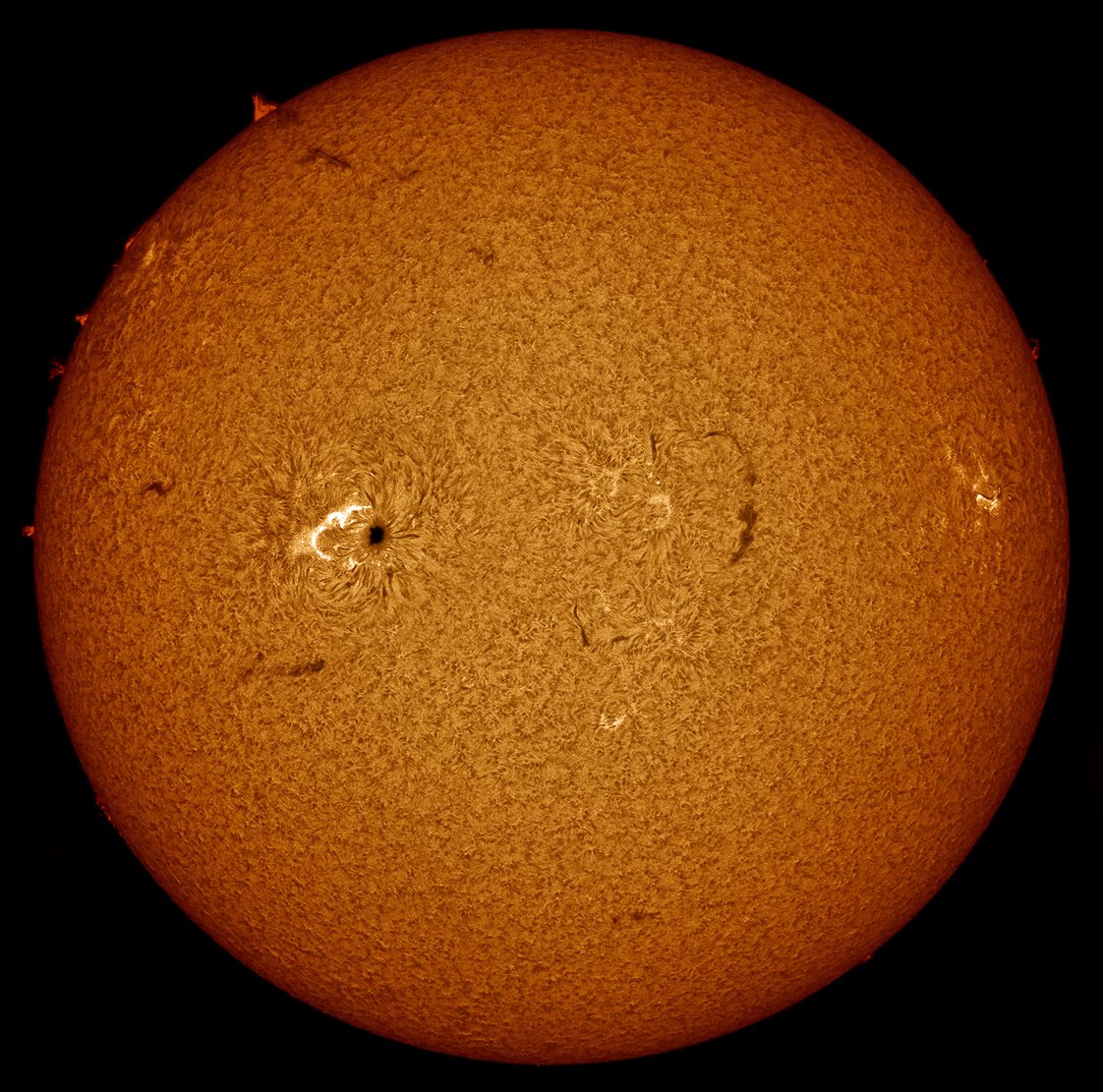
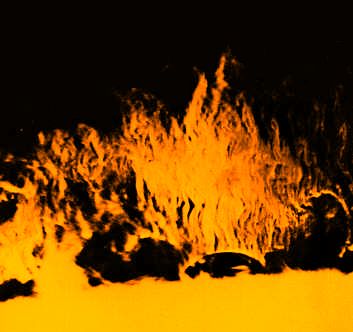
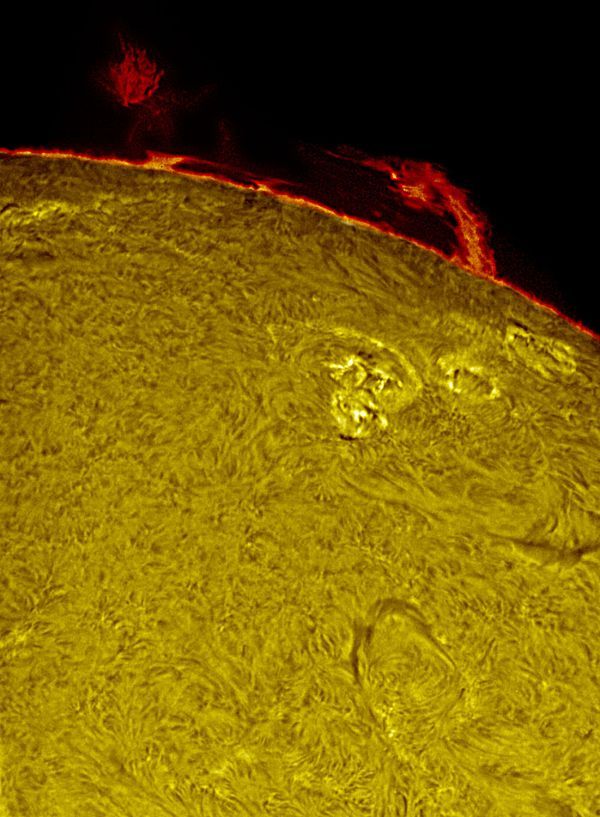
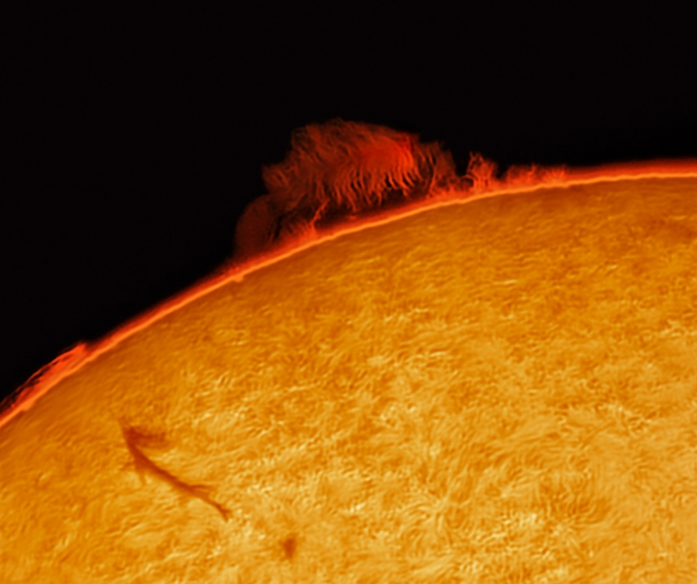
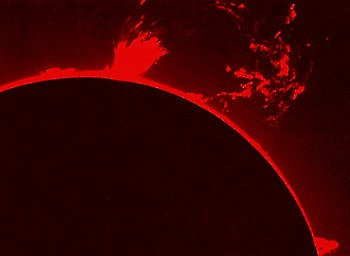
Product review The Sun exhibits various and numbers of interesting phenomena. Among them, the solar chromospheric activity visible in hydrogen-alpha light (Hα) or Ca-II K among other lines counts among the most amazing natural phenomena that may occur on Sun, the only one nearby star that we can observe as long as we can and at all wavelengths. This peculiar solar activity requests also a special equipment because of the nature of the light that we observe. A heavy heat load and a large spectrum at the scope entry will dissolve the light passing through these narrow lines and no more detail will be observed except the yellow solar disk we all known. So in order to observe the Sun surface in hydrogen-alpha, we need to accurately filter a specific spectral line located in the red portion of the spectrum, precisely at 6562.81 Å or 656.281 nm. Although it is the deepest and the largest of the Balmer Hydrogen serie, the intensity or half bandwidth of this spectral line is only 1.20 Å wide. So viewing the Sun through a so small "window" requests a fine-tuned interferential filter. Then we also need to reduce and even eliminate the heat load due to IR radiation that broads the bandpass, and stop UV radiation that shortens the filter lifespan, both radiations damaging also their coating as fast as the sunlight on the anti-reflection coating of wear glasses or sunglasses. The Sun also shows huge prominences on its limb, most being larger that the Earth. If some of these massive emissions of matter are visible during a total eclipse of the Sun, they are not the most spectacular. Good news, we can observe them and many others practically every day and in all their splendor using an interferential Hα filter but this time in working conditions simpler and using a cheaper filter as we can use an interferential filter showing a larger bandpass than the one used to observe surface details (or the same one but in overexposing the image. We will come back on these techniques). At last, in this review, by "solar telescope" we mean a refractor or a reflector using an interferential filter, and not the usual scope equipped with a simple solar filter suited to observe its surface in white light (see this page). The difference is of the uttermost importance for your safety as using the wrong solar filter can harm your eyes to blindness. So never look at the Sun naked eye without sunglasses and check well that the right filter is in place before looking at the Sun through a telescope. Method of observation How work a solar telescope using an interferential filter ? You can look at the Hα Sun on two ways : using a narrow or a broadband interferential filter. The first, limited at an half bandwidth of 0.3 to 0.7 Å will show you the finest detail on the Sun disk, active regions, flares, filaments, plages but you will lose detail in prominences that evolve around the Sun's limb. On the contrary, the broadband filter, due to its larger half bandwidth from 0.7 to 2 Å (or more) will show you first and with a much better contrast solar prominences but only few detail on the chromospheric surface.
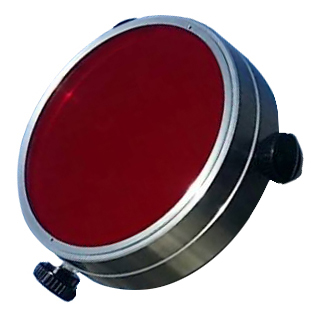
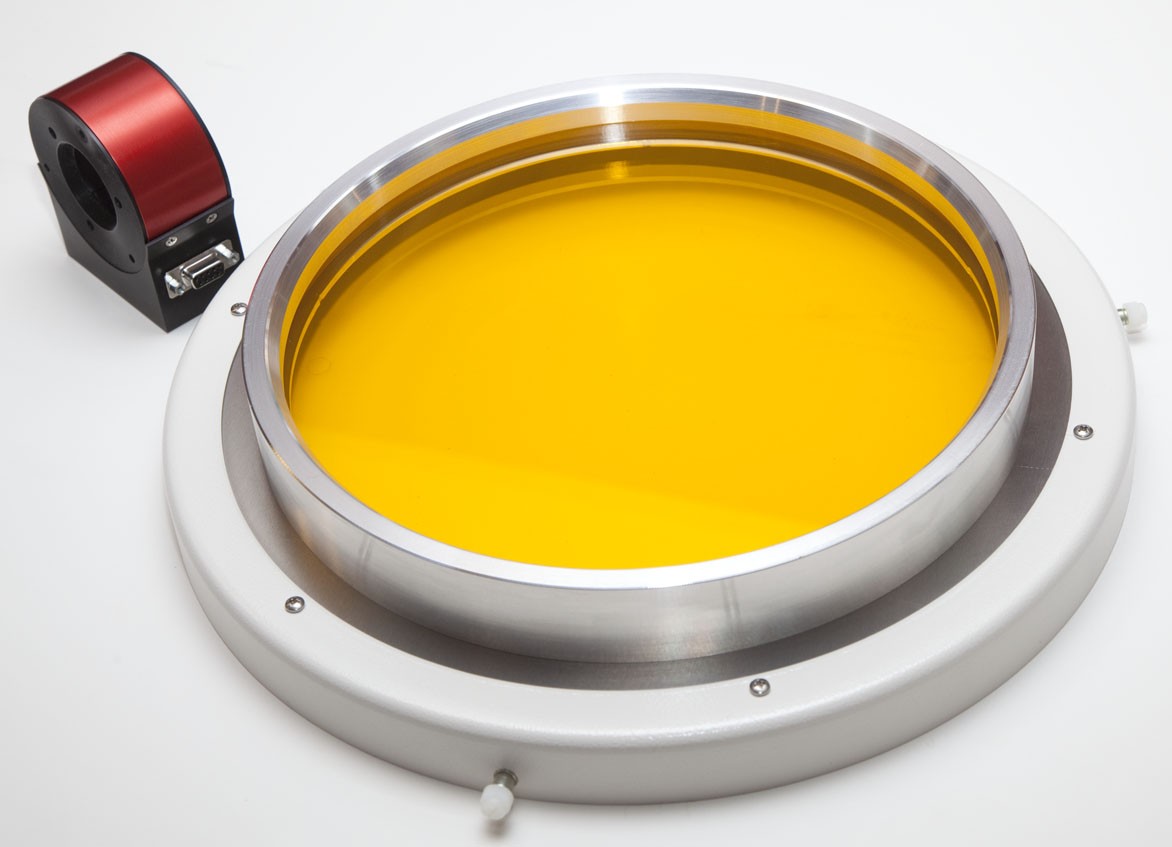
To properly isolate the narrow Hα line (or any other line), most manufacturers have designed an interferential filter which principle is based on phase opposition of undesirable light. A typical Daystar or Lunt interferential filter is actually a Fabry-Perot etalon, which is a pair of very smooth plane-parallel surfaces protected with a multi-layers dielectric coating separated with a solid spacer crystal. Another solution is using a Lyot filter which uses optical activity in crystals as well as sets of polarizers and antireflection coatings to achieve the narrow passband. Due to their design, interferential solar filters work with an additional filter called "Energy Rejection Filter" (ERF) used to block UV radiation and reduce the IR (see below). This ERF is not coated. This dichroic filter of red color and semi-reflecting is usually made of BK7 glass of the highest homogeneity polished to λ/10. It show a half bandwidth of 100 or 45 nm depending on models. Most performing like Baader Planetarium models reject all radiations between 230 and 1500 nm, leaving only open the narrow hydrogene-apha line. Usually ERF filters are guaranteed 10 years. We will come back on ERF filters. Knowing that each f/ stop lost reduces the accuracy of the filter of about 5 to 10 % of the bandpass, it is mandatory to create an optimized optical system. Therefore, the optical assembly has to be configured such a way that the free aperture reaches a specific ratio at prime focus so that the light beam is the most parallel as possible before reaching the etalon filter. Depending on the manufacturer and scopes, most solar scopes work between f/7 and f/30 (e.g. f/4 or f/7 to Lunt, f/6 to Daystar, f/6.6 or f/10 to Meade Coronado, and up to f/15 or f/30 to old Daystar models). This also explains why the largest ERF does not exceed commonly 127 mm and sometimes 160 mm in diameter. But we will see below that are alternative.
What are the components of a solar telescope ? From the "Sun" or front side of the instrument, there is sometimes the Energy Rejection filter that some models installed internally near the etalon, an antireflection window, a diverging lens, then a possible narrowband UV/IR blocking filter, the first etalon window, the solid spacer crystal, the second etalon window, and a possible broadband "trimming" filter. Materials used are just glass, quartz, and various optical coating materials. The quality of components is very important because an interferential instrument is very sensitive to instrumental diffusion, hence the use of lenses of the top quality able to support high magnifications. Note that being given that we observe the Sun in monochromatic light, the image is not subject to chromatic aberration. Therefore we can use an achromatic refractor, much cheaper than an apochromatic model. But for amateurs using the same scope (when it is not a dedicated model) to observe the solar system and deep sky objects, it is better to choose a scope which lenses are well corrected like ED models (or a reflector). An apochromat with 3 or 4 lenses can also be interesting for experimented (and lucky) amateurs using a large refractor at high magnifications if working conditions permit who search for a high-end optics free on aberration, including of coma (probably not visible on solar images but well on stellar images).
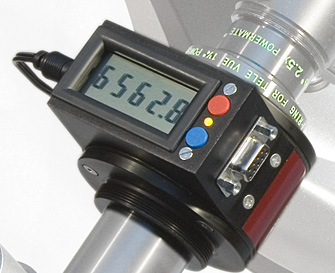
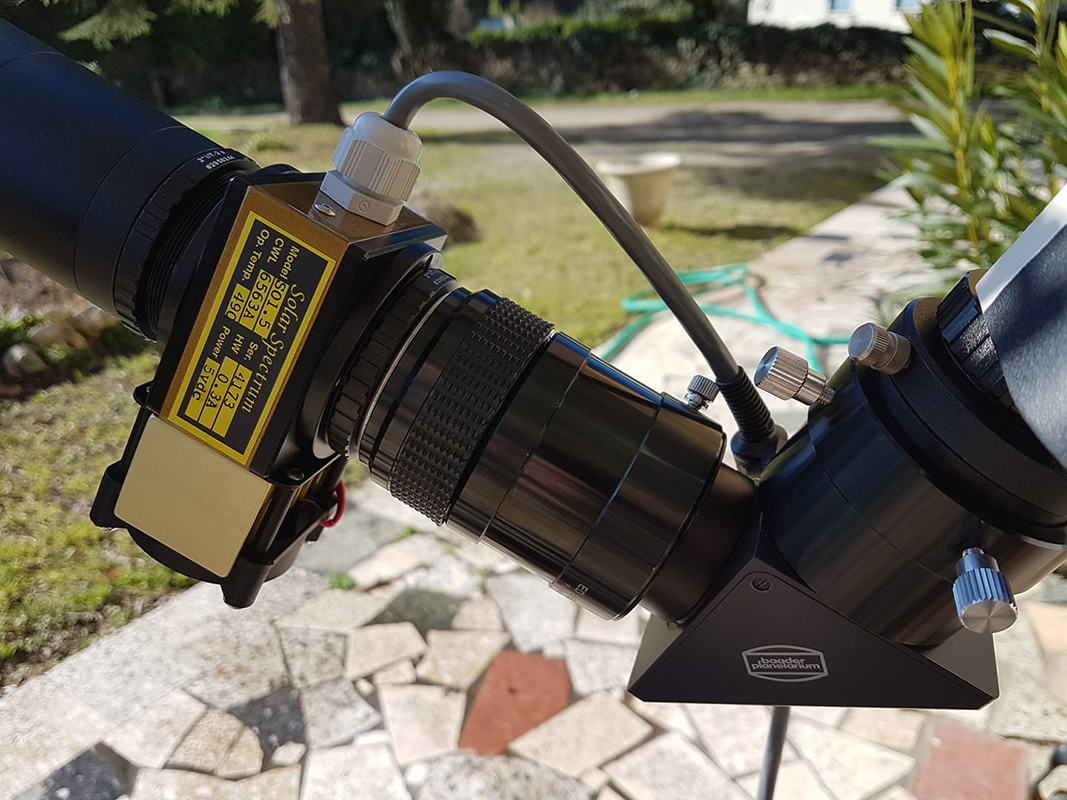
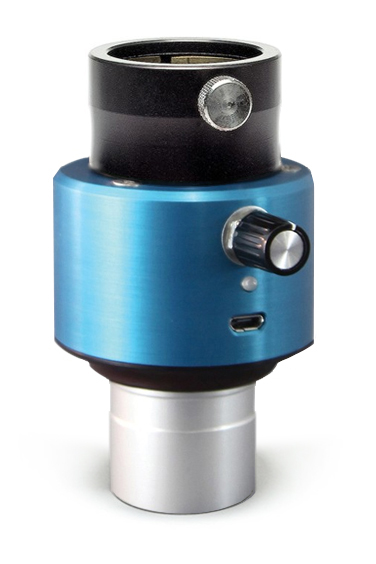
Temperature regulation Solar interferential filters also differ by the modes of tuning and the spectral uniformity. The Daystar Quantum or the old University series for example uses the finest components, it is thermally tuned by a calibrated precision oven and is the most expensive model. It displays images of top quality. The Daystar Quark, Ion or the old ATM is a good compromise and get the best quality/price ratio. Minus side, these filters require an external power for the oven, need a warm-up time and thus cannot rapidly be tuned for viewing Doppler-shifted features. Hopefully, with times some of these solutions were improved and today some Daystars filters can be fed via an USB port. In the past, the Daystar T-scanner series justified its lower price ($1700 with ERF) by using somewhat lower quality optical material and operated between 0-30°C. The regulation of the oven temperature was manually adjustable by moving the tilt of the filter which changes the optical path length through the filter. For a while, a T-scanner suited to the SolarMax scope was available to Coronado. Today, this filter has been replaced by Ion series among others.
But if you can till find a T-scanner on the second market or if you use a Daystar Ion model or a concurrent model using a tilt-tuning (using a gradient) or a pressure-tuning filter, the adjustable tilt in the filter stack offers the advantage to be suited to study Doppler-shifted features like eruptions and flare moving quickly through the bandpass over 45 km/s. Please consult this article about H-alpha trichromy for more details. That said, if we ask to users whether they prefer using a tilt-tuning or a pressure-tuning filter, their replies are very mitigated. In theory, the pressure tuning is superior as it does not use gradient. Some observers have noted that in tilted models, the filter went off-band on the side opposite to the tilt axis, the filter falling outside the "sweet band" centered on 6562.8 Å. Other users playing with the tilt of the etalon got "banding", a contrast anomaly because the angle of the etalon exceeded the tolerance along the tilt axis. But the pressure-tuned filter shows also some defaults as a non-uniform field. For short, all models of interferential filters and any settings can potentially not display the same tuning across the field. Manufacturers are aware to this problem for decades, and to their best to set up their scopes and filters to minimize theses conditions. Of couse, in case of defect, Daystar like the other manufacturers are ready to repair your filter during or even after the warranty period. The temperature regulation stays an important factor using interferential filters. If you buy a filter not properly configured for your climate (cold or warm) it will never display fine images, mainly in the winter when temperature drops below 0°C. You could only use your filter 20 minutes, sometimes less depending on the cold intensity, then the bandpass will go off and you will start to loss detail, mostly surface. Therefore ask at your nearest Weather office for climatology data of your location so that the manufacturer (specially Daystar filters and Lunt) can modify settings of the filter according to a more accurately defined mean temperature. Hopefully, some filters of the last generation are equipped with a thermoelectric regulator. A resolution limited to 1" Usually a solar telescope like the Tele Vue Solaris or Coronado models are small refractors from only 30 to 70 mm of aperture. The problem is that even using a free aperture of 63 mm (2.5" for a 200 mm SCT like a C8), trying to see finest detail in such conditions is a real challenge. Without speaking about the price of a larger instrument, there are some reasons for which most manufacturers don't sell ERF filters larger than 127 mm (the Lunt LS230THA and Baader models remain the sole exceptions). To read : About the Sun and focusing
The main problem observing the Sun is the HEAT. As we know, the Sun causes thermal convection in our atmosphere, heating the ground and buildings around us initiating local convection. So when observing the Sun the air all around us becomes turbulent, creating temperature fluctuations much larger than 0.1 K. This effect affects the refractive index of the air and generates wave front aberrations that limit the practical resolution to around 1", using a 150 mm (6") of aperture or a 400 mm (16") scope. Exceptionnally, at Pic-du-Midi using a 600 mm refractor, in late 1950s B.Lyot and J.Rosch got a photographical resolution of 0.4" and recently telescopes of 2 m of aperture got a resolution of 0.15". Therefore in ordinary conditions apertures larger than ~150 mm are not so useful for any solar work unless you are at high altitude. But we will see below than even in a turbulent atmosphere, there are short periods of calm during which the practical resolution drops to 0.5" or better which we can take advantage. Half bandwidth From a technical perspective, the bandwidth of a filter is always given at mid height of its maximum intensity or 50 % of transmission. It is the reason for which we speak of half bandwidth (HBW or λ50). However, some professionals have given up the "half bandwidth" term to use the word "bandwidth" but it is a source of confusion in the mind of amateurs. For our concern, we will use the term bandpass in this article when speaking of generalities. To see prominences that develop on the Sun limb, a filter showing a half bandwith of at least 0.7 Å is enough, and larger it is brighter will be the prominences (e.g. a HBW between 1-5 Å or even 10 Å). On the contrary, to see surface details in the chromosphere like active regions, filaments, fribrils, etc., a filter showing a half bandwidth of 0.7 Å or narrower is mandatory (usually between 0.7-0.3 Å), the shorter the more detailled will be the image (without taking into account seeing conditions) but it will also be the most expensive.
Resolution The resolution also depends on the working wavelenght. Usually, opticians take a green light at 550 nm to set the optical specifications. However, when observing the sun in Hα light the working wavelenght λ is no more the green light but the red one at 656.28 nm (0.000656 mm). In these conditions, the resolving power (RP) also decreases of a few percents following the next relation : RP = 251643 * λ/D So, using an instrument 90 mm wide offering a resolution of 1.54" in white light, become 1.83" in H-alpha. It is not much, and probably not visible visually in a turbulent atmosphere, but a photography can record this difference, all the more in stacking multiple images. Hopefully the focusing tolerance will be a bit larger. This close our introduction to solar telescopes. Solutions at all prices Let's review now the main products available on the market. If prior the years 2000 Daysar filters was the main manufacturer of solar interferential filters, today the competition is wide open and a handful manufacturers sell such equipments, including complete solar telescopes. Let's start by describing a mandatory accessory, the energy rejection filter, alias ERF. The Energy Rejection Filter (ERF) The energy rejection filter, ERF, can be installed on the front side of the scope to cover the lens of a refractor or of a catadioptric scope, be on or off-axis, or can be inserted at rear and inside the OTA, before the etalon filter where it shows a smaller diameter. The ERF is a dichroic filter that serves many functions. The first is to reduce the light entering the scope by 50-75% out of other bandpass to isolate the Hα line. Its second utility is to prevent the UV light from damaging the filter coatings (which has since been resolved) and broads the bandpass of a few tens of angstroms. It must also prevent infrared radiation to accumulate in the OTA and heat up the secundary mirror of SCT's or other internal elements close to the focal plane. The rejection of UV radiation must be checked (and regulated) with accuracy when doing CCD imagery or studying filtergrams (Hα prints). Thus, before purchasing any ERF, check well that the filter blocks all UV and most IR radiation and only shows a short bandwidth around the Hα line. We will come back on the ERF but already know that all ERF are transparent above 1500 nm, an IR band that also needs to be stopped before entering the etalon filter.
There are till some years ago, all users thought that a solar scope could not work without an ERF. Indeed, Daystar being almost the sole manufacturer for decades, his staff insisted to each customer that using an ERF was the only one way to use properly and safely their interferential filter at f/30. But as we will explain below, since the begin of the 2000's, we found on the market small solar scopes working without ERF. So a question arose among all amateurs : is the ERF mandatory or not ? After years of silent, at the end in 2017 Daystar replied : "No" the ERF is not mandatory but it depends on refractors, and to provide some recommendations. For short, a refractor with an aperture of 80 mm or less does not require an ERF because the amount of energy collected by the lens is too weak to damage the filter system. Their lens and their diagonal reflect more than 99 % of incoming energy and there no risk for damaging any part of the scope, unless it is made of paper...
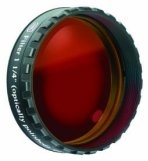
It is only required to use an ERF in combination with a UV/IR cut filter with all scopes above 80 mm of aperture because their beam concentrates more solar energy. The UV/IR cut filter must be placed prior to any other optical element to block all excess of energy, specially prior the possible diagonal (by lack of place some users place it directly onto the Quark filter or the Barlow lens). Daystar also recommends to not use colored glass ERF at rear of the scope because they will break under the heat, and specially on SCT, Petzval refractors, some older oil spaced triplet used without UV resistant oils or any scope for which there is no efficient UV/IR cut solution. A colored glass ERF must maintain the optical configuration and thus be polished to λ/4, and block all visible light below 500 nm if you want to use a Na or He D3 line filter or below 600 nm if you are only interested in the Hα line. At last, as a colored glass ERF also blocks the Calcium line at 393 nm, if you want to use that part of the spectrum, in this case use only a frontal UV/IR cut filter. As all manufacturers or vendors, Daystar has no benefit in encouraging its competitors, and for this reason nobody could ask Daystar for advice about a specific solution at low f/ratio and till less for a custom solution like a prototype of large ERF due to the much too expensive price to develop an unique examplar. But time running, amateurs have looked for other solutions by themselves, some engineers have designed new models of solar scopes, and in ten years the market has evolved. It is so that gradually several new solar refractors of small diameters and low f/ratio appeared on the market at competitive prices. Consequently, Daystar adapted its filters to the demand, and created new solar refractors to attract again his clients and possible prospects about to make an infidelity. Here are a review of the most appreciated solutions currently available. The competition between manufacturers Buying a high quality interferential filter is a huge investment, similar to the one of a good apochromat or a small car. As we all understood, Daystar filters remains the major manufacturer of interferential filters for decades. Today it offer many solutions among them the high-range Quantum, and mid-ranges Quark and Ion series of filters. Its best 0.3 Å Quantum PE grade interferential filter is listed at $14000 but Daystar also sells a SE grade model at $9000, and of course filters offering a larger half bandwidth (from 0.4 to 0.8 Å) at prices ranging between respectively $21990 (PE grade 0.5 Å) or 21990 € to Astroshop, and $5195 (SE grade). Hopefully, for less rich amateurs, we will see that Daystar also offers more economical solutions with its Quark Assembly series at $1195 or 1400 €, without possible taxes and custom duties.
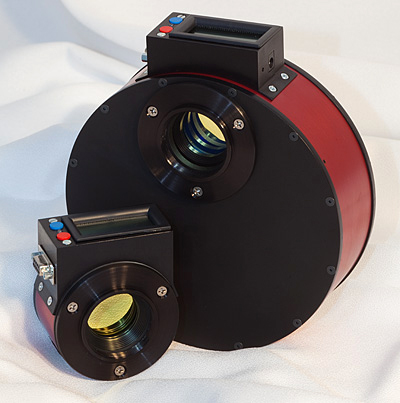
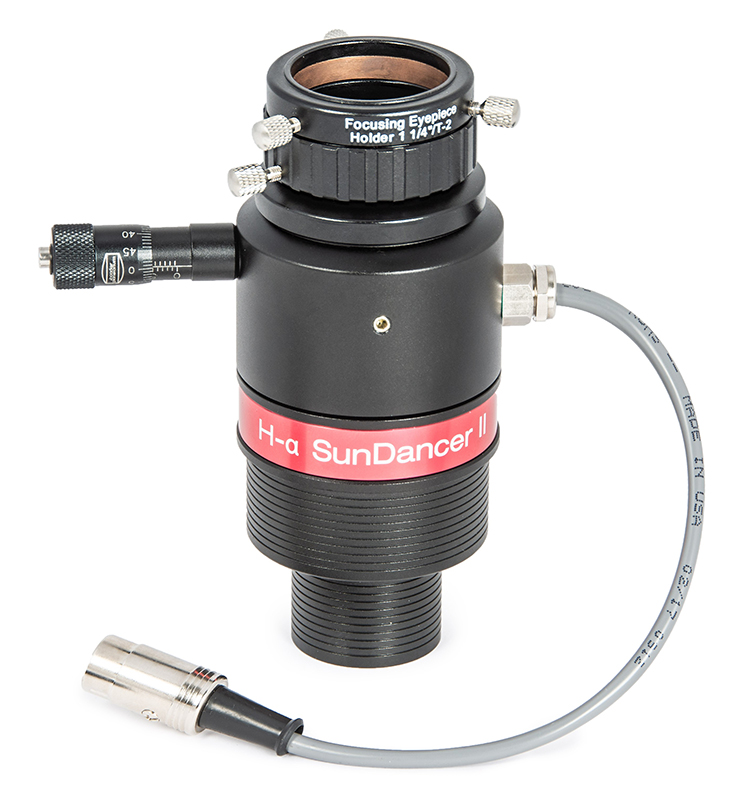
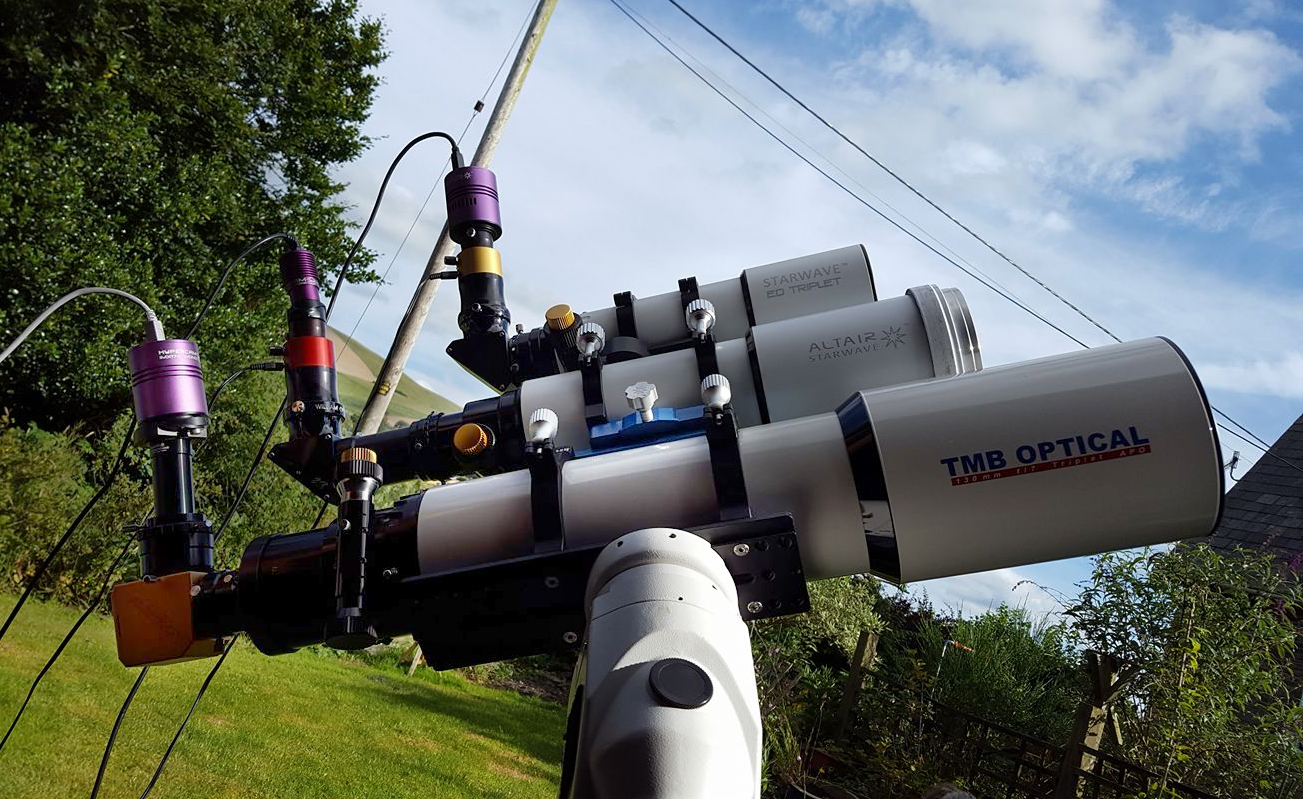
Daystar is also the unique manufacturer to sell an interferential wheel including up to 4 filters although in this case some amateurs prefer using several short-tube refractors installed on the same but sturdier mount like Gary Parker as we see below. Note that a Daystar Wheel with its narrow-band filters reaches sky high prices ranging between $19000 and $35950 plus taxes and delivery. Added to the price of the scope, its mount and CCD means, it is without saying that such accessories are dedicated to scientists or fortunate associations. Note that Sirius Observatories in UK use such a wheel. But even using a single instrument and a single filter, a large solar scope can rapidly reach sky-high prices : a Lunt LS230THa/PT (230 mm f/7, ~200 kg) with an internal etalon < 0.7 Å and a B3400 ERF blocking filter costs 32300 € to APM Telescopes in Germany. A Lunt LS127THa (152 mm f/6) starts at 10500 € and the 60 mm model is at about half that price (see below). The second historical manufacturer is the US company Solar Spectrum Optical Filters that sells filters since the 1980's. In Europe, it is represented by Astrograph (UK) and Baader-Planetarium (D). Solar Spectrum provides interferential solar filters between 380 and 990 nm. Solar Spectrum interferential filters come with a half-bandwidth of 0.65, 0.50 and 0.30 Å and a free aperture of 25 or 32 mm, and in three grades or qualities (Observer, Advanced and Research), plus three Research grade models offering a 46 mm apperture and a half-bandwidth of 0.70, 0.50 or 0.30 Å. Their prices (in 2022) are ranging between 3163-5400 € for the Observer series, 5780-9200 € for the Advanced series, 7210-11700 € for the Research series, and between 10750-15800 € for the Research 46 mm grade series. Unfortunately very few models are in stock. Now, there are two additional filter manufacturers very appreciated by advanced amateurs, the famous Baader that sells among many other accessories a 0.60 Å Sundance II interferential filter (3545 €). Then Coronado, a Meade subsidiary since 2004. Among many other models, Coronado sells a high-end AS1-140 filter offering a free aperture of 140 mm and a half bandwidth of 0.6 Å. Due to its large aperture, its price is ~$12900 ! Note that for a delivery in continental Europe from the USA or the United Kingdom, you need to add to your bill 20% for VAT and between 3.5-17% for custom duties or about 30% of the price. Continental europeans have therefore advantage in buying to a continental dealer, all the more since Brexit.
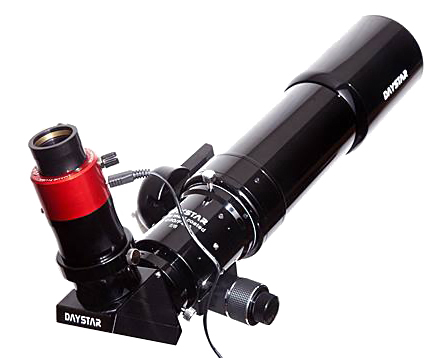
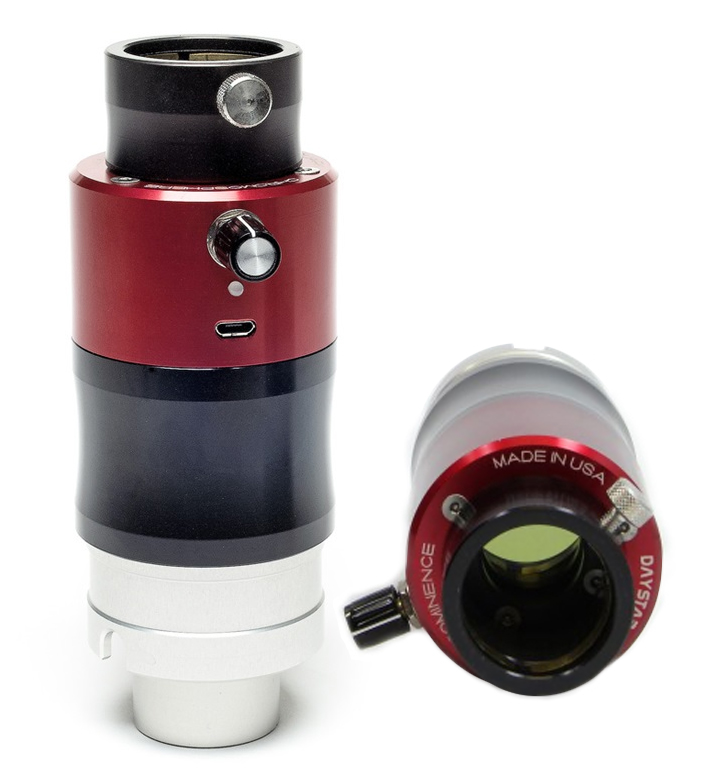
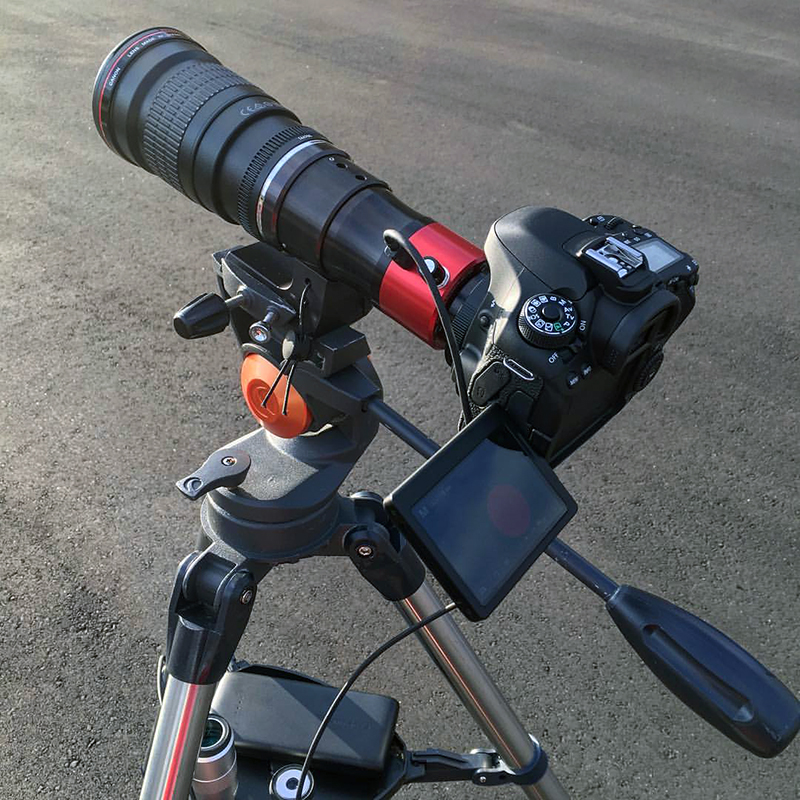
As not many amateurs can afford so expensive accessories, manufacturers have built various premium and cheaper models providing in spite of everything excellents results if you know their limitations, i.e. not pushing the magnification too high on small scopes (e.g. not barlowed over 1.5x on scopes up to 60 mm of aperture to preserve the image quality), all the more when amateurs can postprocess their images (e.g. in stacking multiple frames and applying deconvolution) to improve their quality. So, since the 2010's, in addition to its filters, Daystar also sells several solar telescopes at competitive price : a 66 mm f/14.3 scope (SolaREDi 66 from $1295 with a Quark filter and a 2.3x telecentric Barlow lens), an achromatic doublet 80 mm f/6 (Daystar 80 from $1500 with a Quark Hα or Ca-K filter), and a 127 mm f/32 (Daystar SR-127 from $4000 with a Quantum filter), the price being listed without taxes and additional accessories (mount, eyepiece, CCD or DSLM, , etc.). The good news is that the Daystar Quark interferential filter ($1295 or 1499 € in 2022) is an all-in-one model. Indeed, as we see above, the Quark model includes a 4.3x telecentric Barlow lens, adapters, snouts and the etalon interferential filter into the same compact assembly. Depending on the model, the Daystar Quark filter can be centered on the Hydrogen-alpha line, Calcium-H line or the Sodium-D line. In addition, the Hydrogen-alpha model is available in two versions : chromosphere (HBW of 0.6 Å, ref. A-700Q) and prominence (HBW of 0.7 Å, ref. A-701Q). To
watch : Transit
of Mercury 9 May 2016 Skywatcher Esprit 100 Super APO refractor, Daystar Quark filter, CCD ZWO ASI174-MM
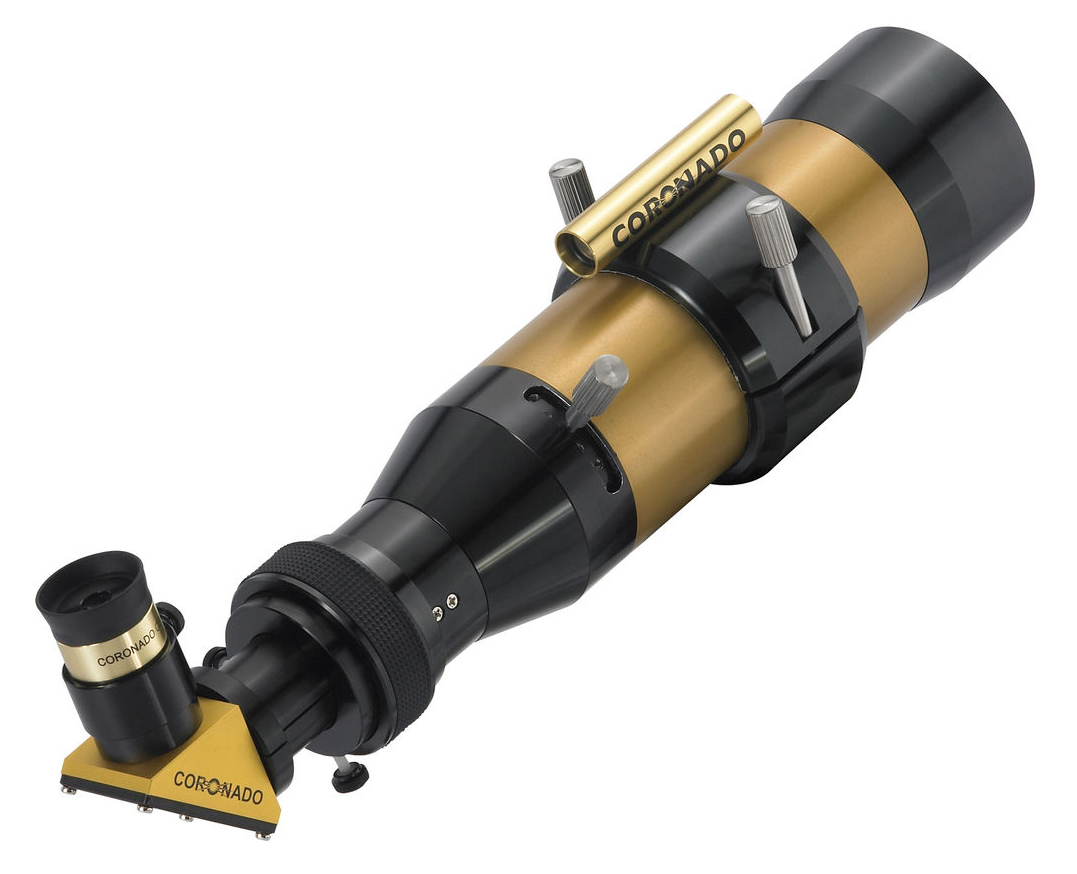
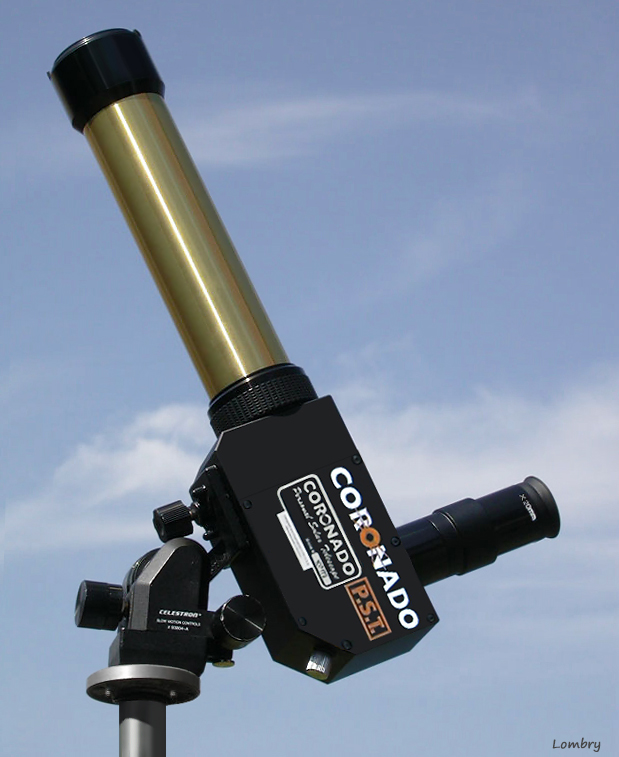
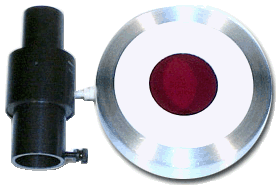
Note that if the Quark Hydrogen-alpha can be used on any refractor between f/4 and f/8 (but the optical system works between f/17-f/34), the Calcium-H model requests a focal ratio between f/7 and f/30. All Quark models work with batteries that last about 8 hours. Ony drawback, as the Quark filter uses a 4.3x telecentric lens, it can be difficult to use it in average or bad seeing conditions (that are common). In this case, the alternative is using a scope with a longer focal ratio with a Daystar Ion filter ($1800, fed on 12VDC) and a Barlow or a Tele Vue Powermate which is a telecentric and converging system. This solution requires a focal ratio of about f/30. To reach it, use either a f/9-f/10 scope with a 3x Barlow, a f/11-f/12.5 scope with a 2.5x Barlow or Powermate or a f/15 scope with a 2x Barlow or Powermate. At last, as explained earlier, it is recommended to use the Quark with an UV/IR cut filter and an ERF filter specific to your refractor for security reasons and to preserve the lifespan of the filter and coatings. Of course and hopefully, there are cheaper solutions. The cheapest solution to observe the Sun on H-alpha light is buying a Lumicon or Thousand Oak Optical 1.5 Å Hα filter which will show you prominences - and only them - in all their splendor. The price is ~$730 with the ERF. Coronado (Meade) sells also the PST (Personal Solar Telescope) model, a small 40 mm f/10 solar scope displayed below right which etalon displays a half bandwidth of 1 Å ($639) or 0.5 Å ($1199). The price of the OTA includes the frontal ERF, the internal etalon and a 20 mm MA eyepiece (barrel size 31.75 mm or 1.25"). Coronado sells also a larger scope, SolarMax II 60 (60 mm f/6.6) at $1500 or 2259 € delivered with a BF-10 or BF-15 blocking filter and a 0.7 Å etalon. A
voir : Quark
Hydrohen Alpha solar eyepiece,
Martin Pyott Solar Observing and Imaging with the Daystar Quark Chromosphere Eyepiece, Jeff Ball Coronado | SolarMax III (SMIII) Series , Meade Instruments
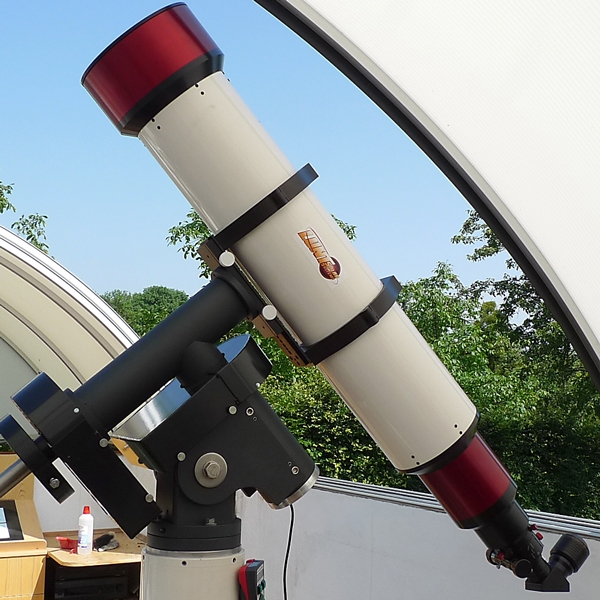
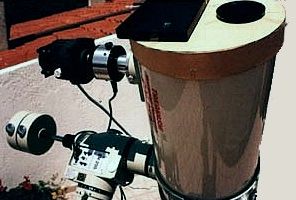
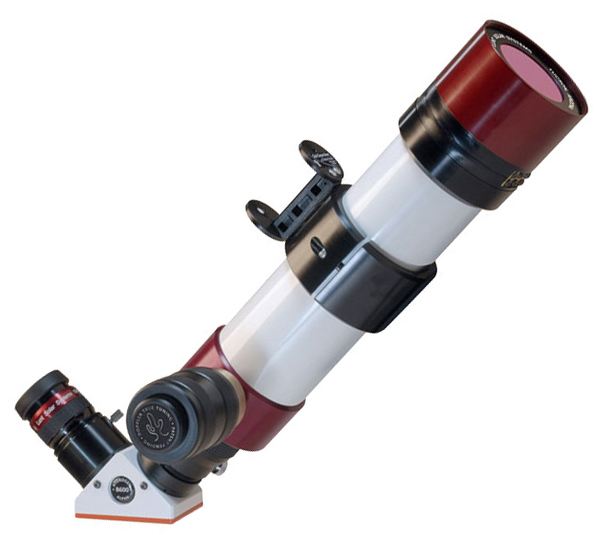
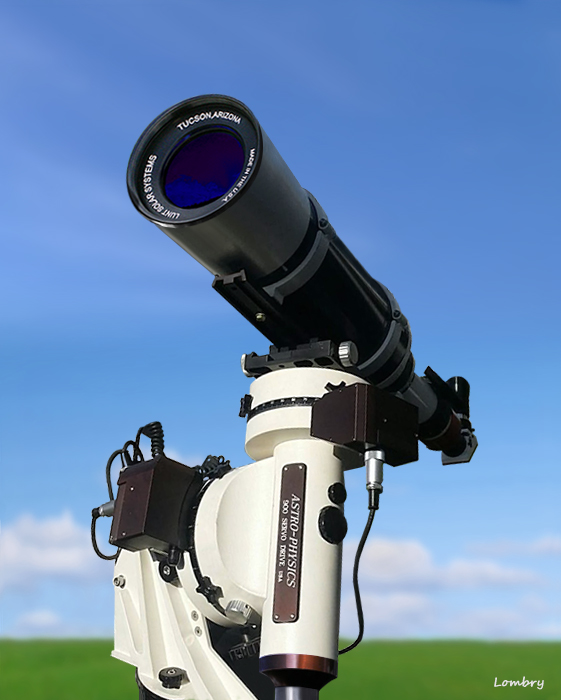
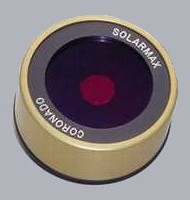
Other manufacturers like Tele Vue has dedicated its small "Solaris" refractor to this activity. This 60 mm f/30 refractor is provided with a Daystar T-scanner 0.7 Å interferential filter. Today this model is sold by Coronado. This brand also sells interferential filters, like the GEMINI model 2.5 Å suited to many scopes. But like Coronado PST or SolarMax 40 scope, its aperture is only 40 mm which limits the resolution of disk detail substantially. But if you are interested in a small solar scope, you can get a 40 mm model for less than $1000 or 1000 € (without mount and usually with a poor MA eyepiece of 20 mm). However, this solution is far to satisfy advanced amateurs, all the less astrophotographers. If you prefer a larger aperture, Coronado offers a mid-range solution : the combination of the interferential filter SolarMax II 90 (aperture 90 mm, HBW < 0.6 Å) to place on the front of the scope and the blocking filter BF-15 to place at rear of the scope. The filter is threaded to attach directly to the front of Tele Vue refractors (101, 102 and Genesis) but can be adapted on any larger objective (e.g. a C8, etc.) using an off-axis mask. However this solution is not really cheap and costs at least $3600 or 5000 €. Lunt solutions Since 2010, Lunt solar systems (represented in Europe to Bresser in Germany) already known for their large LZOS apochromats and their telescopes, sells several solar telescopes starting with a 50 mm model up to 230 mm of aperture as stated above. As all solar telescopes, their scopes require an ERF filter (e.g. Lunt B600 at 500 € for the 60 mm scope) and as we can see below left, you can also add a front-mounted full aperture hydrogen-alpha filter (double-stacked setup) to shorten its bandpass. This filter is available with a 0.5 Å half bandwidth or <0.5 Å using a double-stack filter.
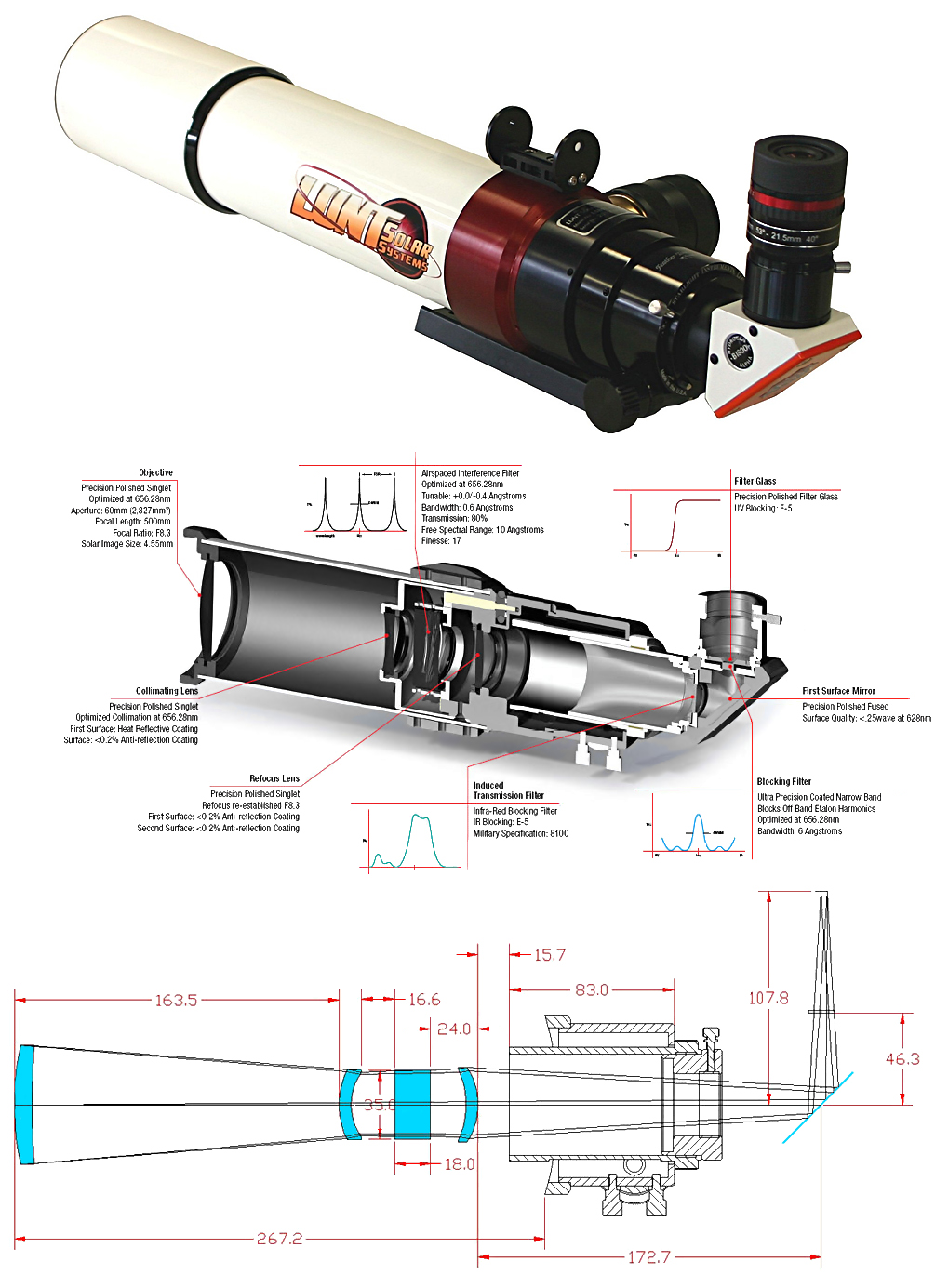
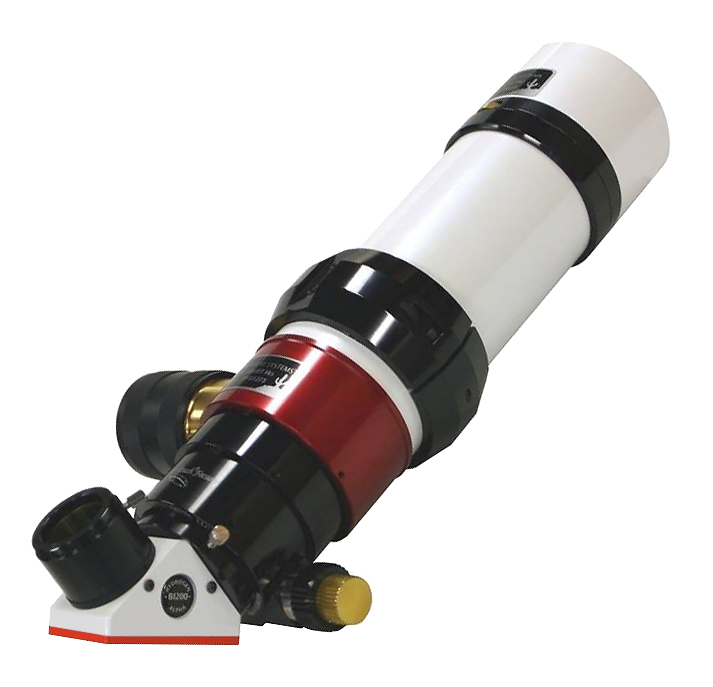
Among the good news, all Lunt solar scopes are delivered in an aluminium suitcase and the scope is protected with foam. As shown on the exploded view displayed on top of the page, The Lunt LS60THa model uses in fact a 64-mm lens showing a focal of 300 mm, the manufacturer having inserted a diverging lens to reach a focal of 500 mm. The ERF (e.g. B1200) is inserted on the eyepiece side what could a priori seems an error due to the possible heat load. But in pratice the ERF shows an internal diameter of 40 mm and there is not risk to heat up optical elements. By the way, looking the scope from the rear, the diverging lens is placed just before the ERF, and the etalon is in front of them. This design is a plus because like in the PST model, we can reuse the etalon in another and larger scope (e.g. a 150 mm achromat or even a larger apochromat). The etalon will be inserted near the focus plane as well, and ideally in combination with a frontal ERF and possible IR blocking filter. At last, the weight of this apparently small and light short refractor nevertheless reaches 2.75 kg without eyepiece nor camera. It is thus a scope that requires a sturdy mount able to support about 5 kg. Note that as all manufacturers, Lunt sells the filter and accessories in addition, increasing quite a lot the bill (rekon $1999 + taxes or 4650 € all charges incl. for a LS60THa with B1200 ERF). Positive point, the Lunt Hα interferential filter can be mounted on any telescope thanks to an adapter that can be purchased separately, even custom made to your specific requirement. New full aperture proposals If you want to use a full aperture ERF on a small scope or an ERF larger than 160 mm (see Baader solutions below), you can experiment one of the next solutions. Some of them were experimented on H-alpha, others never but have already generated a great deal of theoretical discussions on Internet's forums. So, I would like to thank Jen from ICSTARS Astronomy, David W. Knisely from Prairie Astronomy Club, Anthony Seal, Jack and Gordon for their rigorous arguments in favor of these hybrid solutions. Here are the ideas.
One approach to enlarge your optical system aperture is to find a solution similar to the Herschel wedge. The San Francisco Sidewalk Astronomers built a Solar dobsonian using a partially aluminized optical cover platethat rejected 95 % of the solar energy. They drew up a diagram and described this instrument in the September 1971 issue of "Scientific American". Of course at that time this instrument was not set up for hydrogen alpha. But this article might be worth a check. Another solution, being given that most of Hα filters only work fine with f/ ratio longer than f/30, this requisit can be achieved either having a dedicated f/30 system of limited aperture so that the beam is almost parallel at the entrance of the etalon or putting up with a barlowed image. For one time manufacturer Jesse Knight offered an optic with energy rejection coating on the Barlow. This allowed his filters to be used with refractors from 150 ro 180 mm in diameter without ERF. Unfortunately they were no longer available. We can also for example use a Celestron 4.5" of 102 mm f/11 refractor with a 80 mm (3") photographic red filter like RG610 λ/4-wave quality which brought the resulting optical system to f/14.4, then adding a 2x Barlow to reach f/28.8. The same with a Vixen 110 mm f/9.4 refractor which reaches f/12 with a RG610 λ/4 wave filter, then adding a 2.5x Barlow to reach f/30. This kind of configuration is in the general operating range of standard Daystar filters, but it reduces the accuracy of the filter by around 0.1 Å. Worse, the image displays vignetting as the entire field of view is not within the narrow bandpass of the filter. However this solution will give a much better resolution than the itsy bitsy 32 mm (1.25") aperture provided by the Daystar ERF. Daystar sells only two large ERF, a 125 mm (5") off-center model for Meade LX 200 16" of 400 mm of aperture, and a 150 mm (6") full aperture on-axis model. Baader in Germany provides also several large ERFs (see below).
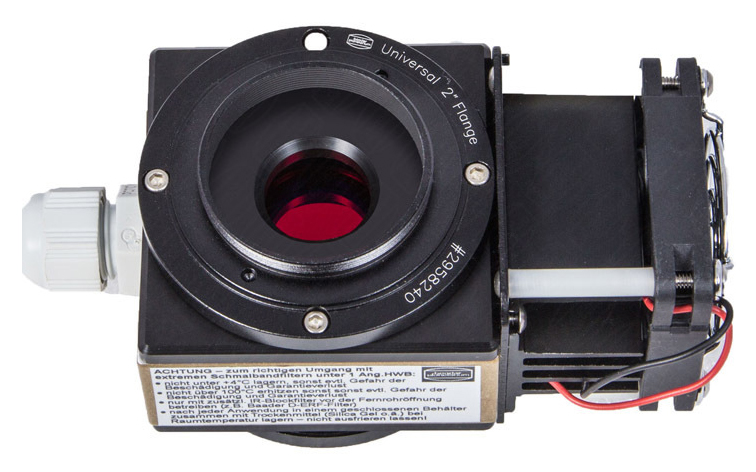
Note that you don't need to throw away all the light gathering power of your glass using for example a Mylar sheet or a Baader AstroSolar film to keep the heat out. You could take a compromise and get a 80 mm ERF, mount it off-axis and use your Barlow or Powermate to reach the appropriate f-ratio. Another argument is the price. For a 250 or 300 mm (10 or 12") scope, a full aperture RG610 glass would cost a fortune and may likely not be available. The last solution is the most interesting. We have seen that the barlowed image is degraded. Except the vignetting, the Barlow is a negative lenses system which amplifies the "field angles" of the incoming light, resulting in the "ring effect" and a limited passband field of view. To ensure a decent image without vignetting, we can use a telecentric optic to get intrinsic long f-ratio, specially to get the mandatory f/15 or f/30 ratio. Recently Astro-Physics and Baader introduced the telecentric optic allowing large ERF to be used with a shorter optical system. If the Ion or Quark from Daystar is too expensive for your budget, you can ask Daystar to design a 100 mm (4") ERF suited to a NexStar 5" of 127 mm f/10 for example, and using a 2.5x Powermate. The resulting beam is f/31, nominal for the Daystar but using a 100 mm aperture. I bet this time you will get a finer solar image, sharper than using any Barlow with the advantage to give you a view of the entire solar chromosphere at once instead of just a ring-shaped patch of detail. Several amateurs tested the above solutions successfully. Enyo brothers for example use a 0.7 Å Daystar with a 4x Tele Vue Powermate fixed on a Tele Vue 101 refractor while John uses the AP Telecentric unit in place of the Powermate. Both work well. John also bought a 77 mm ERF from Lumicon - which quality is really similar to two photographic filters - for his AP 130 mm. David Knisely uses his 250 mm f/5.6 Newtonian stopped down to 89 mm or 3.5" (f/15.7), which then becomes about f/39 with a 2.5x Powermate. The detail is extremely good (when seeing supports it) all through the field of view, and he has used the T-scanner setup at powers up to 220x, although most of the time, he stays around 117x. Baader solutions At last, if you prefer to invest your money in a smaller interferential solar scope but taking advantage of the full aperture of scopes in the range 70 to 180 mm in diameter, know that Baader Planetarium in Germany provides several interesting solutions : - Interferential filters - ERF filters - A prominence viewer. Interferential filters Baader sells several H-alpha filters : a mid-range 0.60 Å Sundance II interferential filter (3545 €) described previously but also cheaper models including a 650 and 450 Å half-bandwidth passfilter (94 €) suited to 50 mm (2") eyepieces and 6 Å and 1.5 Å half-bandwidth models suited to 31.75 mm (1.25") eyepieces (~685 €). These cheap filters are equipped with parallel glasses polished at λ/4. These two latter are only suitable to observe or picturing prominences with a prominence viewer like a coronograph.
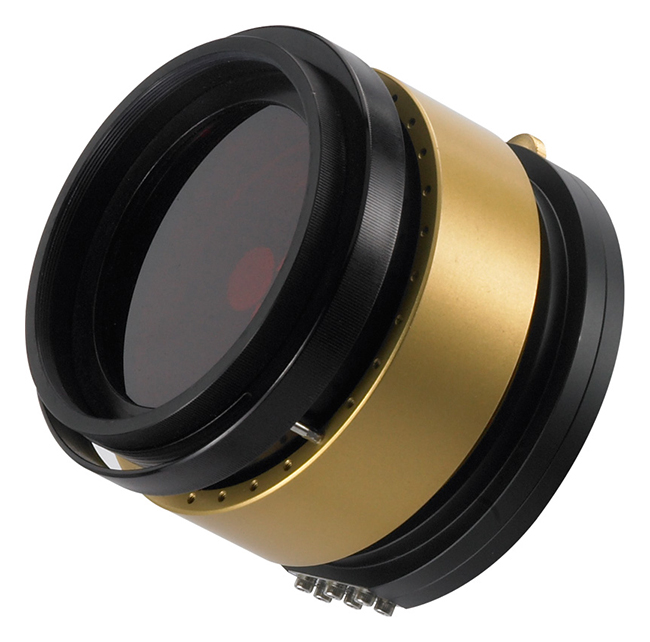
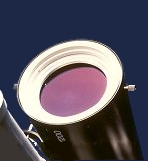
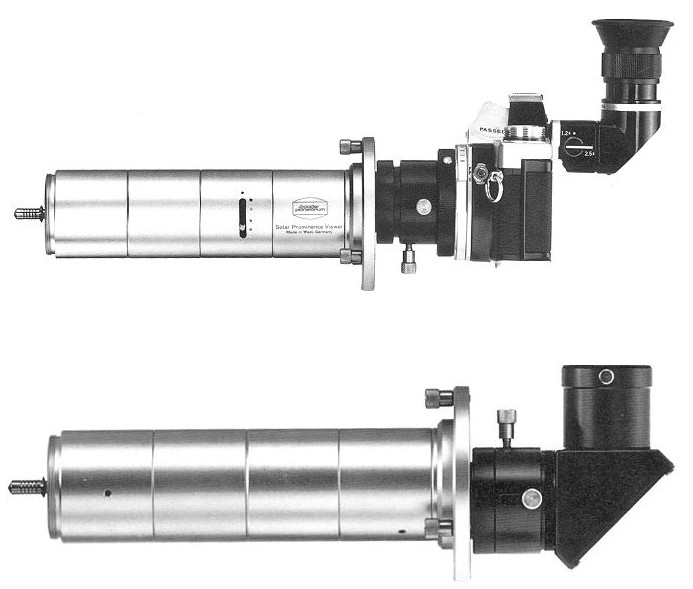
Baader ERF All solar H-apha scopes and interferential filters request an ERF in front of the etalon to reject a maximum of UV and heat (IR radiation). Baader manufactures a series of 450 nm wide front energy rejection filters (C-ERF) polished at λ/10 wave and ranging in size from 70 up to 160 mm in diameter (485 € for a 110 mm model). These filters are being used as pre-filters to cover the entrance aperture of the telescope. Baader uses these "cool" ERF in combination with all their H-alpha filters. Good news, you have not to worry about the f/ratio of your optical system or any other consideration as in using a Daystar or a Coronado filter. ERF manufactured by Baader reject all UV down to 280 nm and IR up to 1500 nm. As highlighted above, if it is enough on the UV side, there are till many IR radiation passing through the ERF between 1500 and 5000 nm that it is recommended to filter too using an additional IR blocking filter. NB. Baader also sells another 450 Å passband filter for 50 mm (2") eyepieces with a λ/4-wave polish but it is reserved for Deep Sky CCD-work together with SBIG interline and full frame chips. It is not intended for solar work ! Prominence viewer If an interferential solar filter at wideband (1.5 Å wide and up) prevents to see details on the solar surface, why not using a coronograph ? In this regards, Baader sold during the 1990's and 2000's a 80 mm prominence viewer that was reviewed in "Sky & Telescope" ("The Baader prominence coronagraph" by Trombino, Donald F., June 1994, Vol. 87, Issue 6, p51).
This accessory is constituted of a mask that comes inside the tube of Vixen 80 mm refractors from 800 to 1600 mm of focal length. Its external ends is equipped with a star diagonal of 31.75 mm (1.25") and can be equipped with any DSLR/DSLM, a CCD or even a high-speed CMOS camera. It supports all Baader interferential filters from 9 to 1.5 Å. Its price was 1595 € but is no more in production. We sometimes find one for sale on the second hand market, e.g. a Astromart (mainly read by US and UK amateurs but most accept to deliver worldwide). Lifespan of H-alpha filters A typical Daystar T-scanner filter can last years without the least problem before to be recoated. Apparently, the early blocking filters (bought in 1980-1985) did not last more than about 15 years of extensive use (a few times per week).
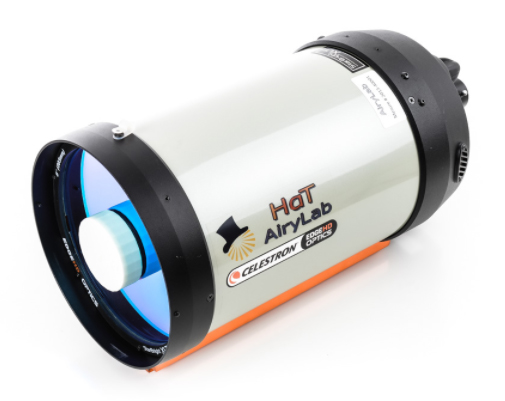
The first symptoms are a loss of contrast and light intensity in one side of the field. Still, the repair cost much less than buying a new filter, about $300, and once servicing the filter is still performing for a new 15 years or so. Some owners used their Daystar about 16 years before experimenting trouble with their blocking filter. This is thus a very good investment. Today Daystar has changed the blocking filter a bit, possibly at an attempt for a still longer lifespan. Depending on models, their filters have a 5-year or 10-year warranty. A good practice to avoid trouble is to never use an interferential filter without the ERF and an efficient UV/IR blocking filter. Note that Daystar itself specifically recommends to *not* use its filters without ERF or heat and UV will damage the filter, what confirmed AiryLab. And of course, recommendations have to be respected, specially the minimum focal ratio to use. So in order to keep you filter in good state, do respect its specifications to the letter. There are not many information about the lifespan of Coronado or Baader interferential filters. But according to their specs you should keep them as long as any colored filter, even used one hour each weekend, thus if you take well care of them, you can use them all your life. AiryLab HαT solution (withdrawed) For some years (2014-2020) the former optical company AiryLab offered to amateurs a real opportunity to picture the Sun in high resolution, specially in Hα but also in a large red band, using a customized Celestron EdgeHD C8 (203 mm), C9.25 (235 mm) or even C11 (280 mm) at full aperture, a first in the world and a long-awaited solution. Unfortunately AiryLab does no more exist and no one has taken over the marketing of this solar telescope. This information is provided only for memory.
For short, as we see at right, AiryLab applied on the frontal lens of these renowed catadioptric telescopes an ERF coating better than λ/4 at 635 nm showing a half bandwidth of about 120 nm, transparent between 580-700 nm, and adds a 2.7x telecentric lens to achieve the optimum focal ratio of f/27.5 or optionally f/35 for users who can benefit of excellent seeing conditions. Note that infrared tests performed by AiryLab have shown that the internal OTA temperature is never warmer than the ambiant temperature and can even be a bit colder, to the benefit of a more stable image. As highlighted above, knowing that the ERF does not block all harmful radiations and that the etalon is sensitive to a wrong setting, by security and specially for users of a PST filter, AiryLab recommended to use it in combination with an UV/IR blocking filter in order to reject not only UV but also all near-IR radiations between 1000 and over 5000 nm to preserve the lifespan of the coatings and the etalon filter. In fact, this recommendation is valid for all solar scopes. The solution provided by AiryLab allowed the use of all standard Fabry-Perot etalons available on the market (Daystar Quantum, Coronado PST, Baader Solar Spectrum Solar Observer, etc.) including double stacked filters inserted at rear of the scope without obstruction up to a diameter of 44 mm. The price of a dedicated "HαT" C8 OTA modified by AiryLab including its full aperture ERF and a telecentric lens was about 4800 € VAT included. With an additional Daystar Quark filter, its price was about 6000 €. Note that if you add the mandatory accessories (an UV/IR blocking filter, the mount, a CCD, and some small items), you can easily add 2000 € to the bill and even explode it if you use a very performing mount and CCD. That means that for a budget of about 8000 € you can get a complete C8 HαT that can reach its maximum resolution of 0.7" in best seeing conditions. Knowing this, the price of this innovation becomes all relative. Note that complementary to the Celestron HαT (but also any other type of scope used to picture the Sun), since 2022 Miratlas (and previously AiryLab) provides a Solar Scintillation Monitor (SSM) to check the atmospheric turbulence and take advantage of the best seeing conditions to take pictures of the Sun in high resolution. Being not specially dedicated to Hα, it is shortly reviewed in the page dedicated to some useful accessories for your scope. For more information On this site Gallery of masterpieces (the Sun in H-alpha) Manufacturers and Clubs (via my 1001 links) Le Soleil en lumière de l'hydrogène alpha (in French on this site) On the web Living Reviews in Solar Physics (webzine), Springer Solar Astrophysics, Scholarpedia Hydrogen Alpha Solar Observing Program, The Astronomical League Cloudy Nights (reviews) Lunt solar systems products overview, Company Seven Astroshop (B, F, D, I, E, P, Pl) APM Telescopes (D) Beloptik (D) Astrograph (UK) Coronado (Meade USA) Daystar filters (USA) Lumicon (USA) Lunt Solar Systems (USA, Europe) Miratlas (F) Solar Spectrum Optical Filters (USA) Tele Vue (USA) Thousand Oak Optical (USA) Books
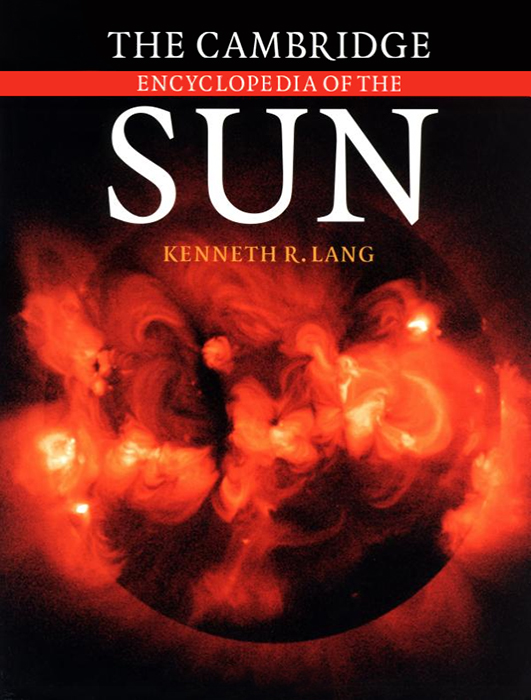
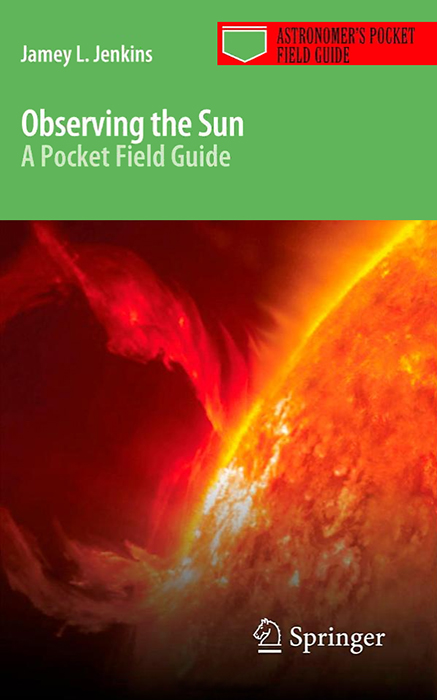
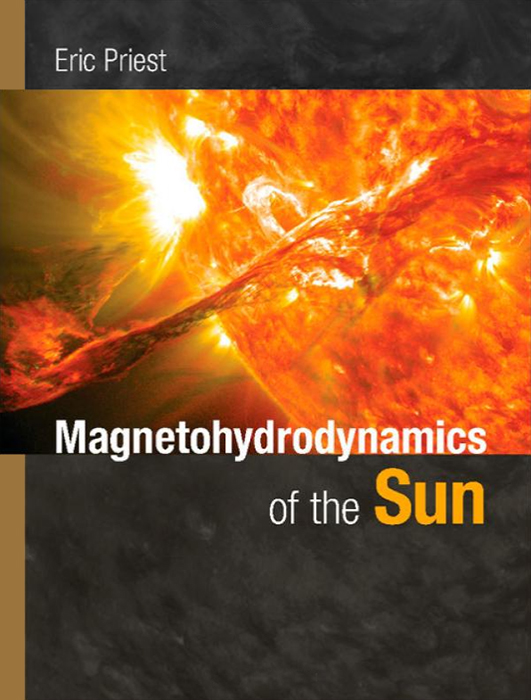
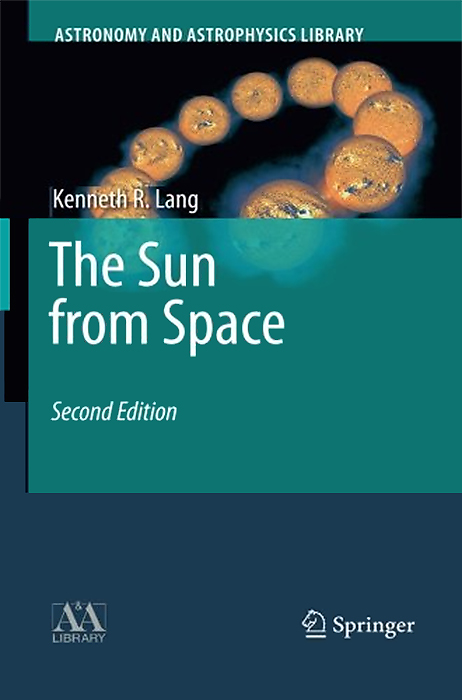
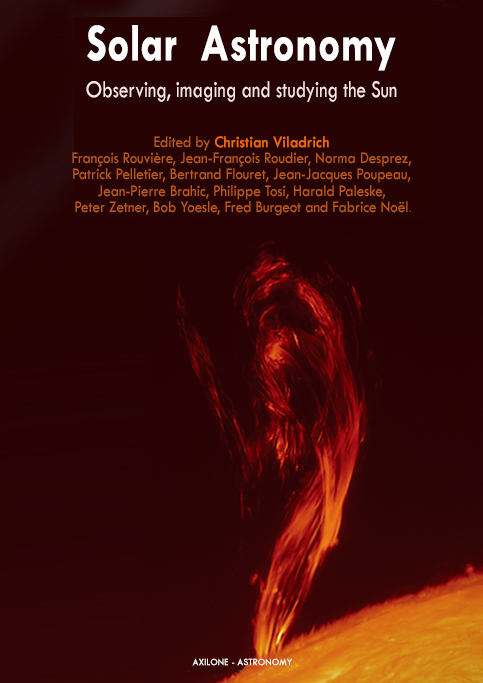
Solar Astonomy (Astronomie solaire), C.Viladrich et al., Axilone, 2021 (2018) 15 Million Degrees: A Journey to the Centre of the Sun, Lucie Green, Viking, 2016; Penguin Books Ltd, 2017 Magnetohydrodynamics of the Sun, Eric Priest, Cambridge University Press, 2014 Identifying Solar Features (PDF), ch.2 du livre "Observing the Sun" de J.Jenkins Observing the Sun: A Pocket Field Guide, Jamey L. Jenkins, Springer-Verlag, 2013 Illustrated Glossary for Solar and Solar-Terrestrial Physics, s/dir A. Bruzek et C.J.Durrant, 1977/2011, Reidel Heliophysics: Space Storms Radiation: Causes Effects, Carolus J. Schrijver, Cambridge University Press, 2010 Solar and Stellar Magnetic Activity, Reissue Edition, Carolus J. Schrijver et Cornelis Zwaan, Cambridge Astrophysics, 2008 Solar Astrophysics, Peter V.Foukal, Wiley Interscience, 2004/2013 The Cambridge Encyclopedia of the Sun, Kenneth R. Lang, Cambridge University Press, 2001 The Sun from Space, Kenneth Lang, Springer, 2000/2016 Solar Astronomy Handbook, R.Beck, Hilbrecht et al., Willmann-Bell, 1995 Guide to the Sun, Kenneth J.H. Phillips, Cambridge University Press, 1992 (reprint 2008) Observing the Sun, Peter Taylor, Cambridge University Press, 1991/2008 Astrophysics of the Sun, Harold Zirin, Cambridge University Press, 1988 The internal constitution of the stars, Arthur S. Eddington, Cambridge University Press, 1926/1988. The Sun, Charles Young, 1881. |
|||||||||||||||||||||||||||||||||||||||||||||||||||||||||||||||||||||||||||||||||||||||||||||||||||||||||||||||||||||